
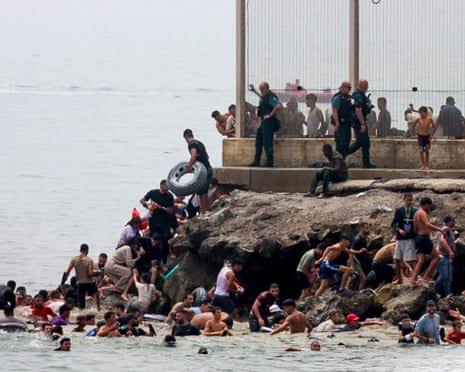
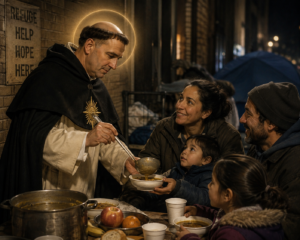
 In the Summa Theologiae (I-II, Q. 105, Art. 3; 1274), Saint Thomas Aquinas examines the old judicial precepts of the Law of Moses regarding foreigners. He explains that a wise society must balance charity and justice toward strangers with the practical duty to protect the common good, handle integration gradually, and prevent social instability.
The Gradual Order of Integration . . .
Aquinas notes that ancient Israel did not grant full citizenship or fellowship to all foreigners right away. Instead, a phased order was used:
Immediate outsiders or recent arrivals: Were treated with basic fairness and human hospitality, but could not immediately vote, rule, or change the nation’s core laws.
Later generations: Full incorporation into the community’s citizenship privileges was reserved for later descendants (such as the third generation for certain groups).
The reasoning: Rushing citizenship to unintegrated newcomers posed a risk to the state, because people who do not yet share or understand the nation’s common good might unintentionally harm or disrupt it.
Protection of the Common Good . . .
Aquinas emphasizes that a community must safeguard its cultural, religious, and social unity:
Proportion and absorption: A society can healthily absorb newcomers only if the influx remains proportional to its capacity to integrate them.
Preserving peace and values: If a nation is overwhelmed too quickly, it loses its shared identity and ability to maintain peace.
Distinction among nations: The Mosaic law made distinctions based on how hostile or peaceful a foreign group’s disposition was toward Israel, treating peaceful neighbors with greater openness while keeping dangerous elements at a distance.
Please proceed to the next article concerning the Law of Moses concerning migrants, and/or click NEXT.;
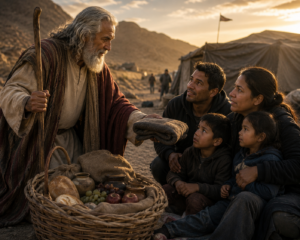 The Law of Moses distinguished between a temporary outsider (nokri/zar) and a resident alien or sojourner (ger). Judicial precepts commanded Israelites not to oppress the ger, granting them legal fairness in courts, inclusion in the Sabbath and welfare provisions like crop gleanings, rooted in Israel’s memory of being enslaved in Egypt.
Legal Protection and Equality . . .
The Mosaic code mandated structural fairness and justice for foreign residents living within the community:
Impartial Justice: Judges were instructed to give identical legal hearings to native Israelites and foreign residents alike (Deuteronomy 1:16).
Equal Standards: Civil penalties and legal accountability for major crimes applied equally to both the citizen and the sojourner (Leviticus 24:22).
Protection from Exploitation: Israelites were strictly forbidden from perverting justice against an alien or withholding the daily wages of poor laborers (Deuteronomy 24:14–17).
Welfare and Economic Provisions . . .
The judicial precepts by Moses included systematic economic safety nets for the vulnerable, explicitly including foreigners:
Harvest Gleanings: Farmers were required to leave the edges of their fields, fallen grapes, and unharvested olives for the poor and the resident foreigner to gather (Leviticus 19:9–10, Deuteronomy 24:19–21).
Social Welfare: Foreigners shared access to portions of the community tithes alongside local orphans and widows (Deuteronomy 14:28–29).
Economic Distinctions: While general interest was forbidden among community kin, charging interest was permitted to temporary foreign traders (nokri) whose permanent residence was abroad (Deuteronomy 23:20).
Religious and Social Integration . . .
A sojourner’s integration into Israelite society depended largely on their level of assimilation and commitment to the community’s covenant:
Communal Rest: Foreign servants and resident aliens were required to rest on the Sabbath day just as native Israelites did (Exodus 20:10).
Religious Participation: A foreigner could partake in sacred national celebrations like the Passover, provided the males in their household underwent ritual circumcision to align fully with the community (Exodus 12:48–49).
Please continue to PART 6 to conclude this module. Click NEXT.
 (Data: ibid, Zeigler)
- At 15.8 percent of the total U.S. population, the foreign-born share is higher now than at the prior peaks reached in 1890 and 1910. No U.S. government survey or census has ever shown such a large foreign-born population.
- The current numbers have rendered Census Bureau projections obsolete. Just two years ago, the Bureau projected the foreign-born share would not reach 15.8 percent until 2042.
- The 53.3 million foreign-born residents are the largest number ever in U.S. history; and the 8.3 million increase in the last four years is larger than the growth in the preceding 12 years.
- The above figures represent net growth. New arrivals are offset by outmigration and deaths in the existing immigrant population. Our best estimate is that 11.5 to 12.5 million legal and illegal immigrants settled in the country in the last four years.
- Although some immigrants are missed by government surveys, our preliminary estimate is that there are 15.4 million illegal immigrants in the January 2025 CPS, an increase of more than 50 percent (5.4 million) over the last four years in the survey.
- In the last four years, Latin America accounted for 58 percent (4.9 million) of the increase in the foreign-born, India 12 percent (958,000), the Middle East 8 percent (690,000), and China 7 percent (621,000).
- Of all immigrants, 60 percent are employed. As in any human population some work, but others are caregivers, disabled, children, elderly, or have no desire to work.
- Since 2000 the number of immigrants working has increased 83 percent and stood at 31.7 million in January 2025 — 19.6 percent of all workers.
- We estimate that 10.8 million illegal immigrants worked in the January 2025 data, accounting for some 6.7 percent of all workers. Illegal immigrants in particular are heavily concentrated in lower-skilled, lower-paid jobs, typically done by those without a bachelor’s degree.
- The rapid rise in immigrant workers has coincided with a significant increase in the share of U.S.-born (ages 16 to 64) men without a bachelor’s degree not in the labor force — neither working nor looking for work — from 20.3 percent in 2000 to 28.2 percent today.