


DATA-PROCESSING CENTER WATER USE
.
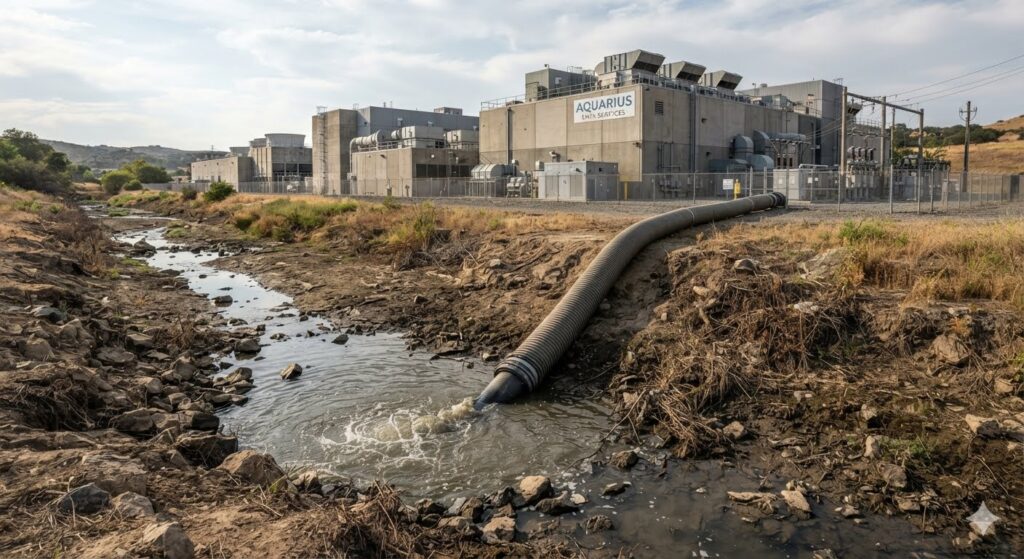
Most of the images used on this EEP/NE-TACA Web site were generated by Artificial Intelligence. The public water that cools the processing plant of the nearby community A.I. data center is being compensated for, as it pertains to church and school usage, by harvesting rainwater from the roof of the EEP/NE-TACA office. The approximated consumed amount of 13 gallons is mentioned in the data-analysis below.
.
U.S. data centers directly consume an estimated 449 million gallons of water per day, totaling over 163 billion gallons annually. A significant share of this water comes directly from municipal public water systems for cooling, though total indirect usage tied to power generation is much higher.
.
A typical mid-size center uses 300,000 to 500,000 gallons per day (similar to 1,000 U.S. homes). A large hyperscale/AI center uses 1 million to 5 million gallons per day during peak operations, which is similar to a town of 10,000 to 50,000 people (Myths vs. Reality: Data Centers And Water Usage; Ganesh Hegde, KETOS; Florida; Water & Pollution Control Operators Association, 1/23/2026).
.
“And the Lord spake unto Moses and Aaron, Because ye believed me not, to sanctify me in the eyes of the children of Israel, therefore ye shall not bring this congregation into the land which I have given them” (Numbers 20:12).
.
Moses was punished. Intending to produce water for the thirsty plaintive Israelites, he had struck his staff upon the rock at Meribeh without invoking the permission of God, and, being God’s anointed leader, had refused to command the rock to obey Him. Resultantly, God disallowed Moses and Aaron entry into the Promised Land. More than 3,000 years later, water is again cynically being used to feed the machine of faithless distraction, drought, and deprivation.
.
A typical Web influencer or artist produces 100 individual images on ChatGPT per month, which uses an estimated 0.4 to 13.2 gallons of water from a data center in total. This breaks down to roughly 0.004 to 0.13 gallons (15 to 500 milliliters) per single image, depending on the server cooling efficiency, local climate, and whether off-site power generation water usage is included. There are hundreds of thousands of people in a typical metropolitan area, who are constantly endeavoring creatively as such. There are many hundreds of such metro areas in America. Water is needed to cool the systems.
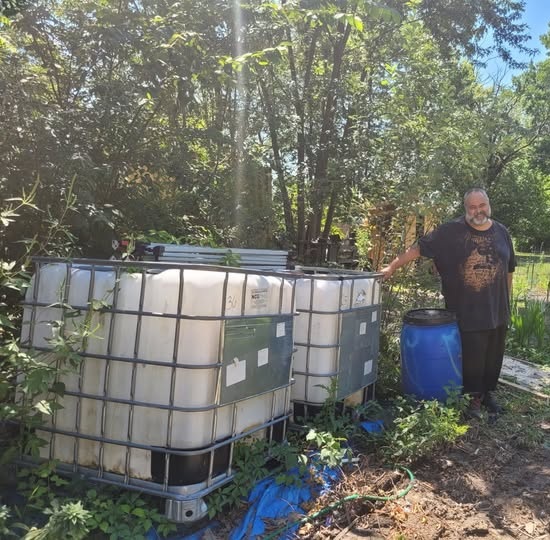
The classroom and vestry of the Ecclesiastical Ecumenical Province of NE-TACA execute their water-harvesting by channeling rainwater from their roof into a 273-gallon IBC tank and a 55-gallon blue PVC barrel (see photo at left). This offsets the public cost of its own Internet use.
.
Ministers should know and preach that waterways nationwide are slowly being sucked dry. Let us take account of the executives of these centers as they pocket resultant fortunes while making ourselves less dependent on the Internet for our lives.
.
Factors Influencing Water Use:
.
Direct Server Cooling: Water evaporates in cooling towers to manage the heat generated by intensive GPU calculations.
.
Energy Production: Generating the electricity to power the data centers often requires additional off-site water usage at power plants.
.
Geographical Location: Data centers in warmer climates (like Arizona) rely heavily on evaporative cooling, whereas cooler regions use far less water.
.
Various Searches H20-Use Quantification:
.
Generating 1,000 traditional Google searches uses roughly 0.13 gallons (about 0.5 liters or roughly 1/10th of a gallon) of water directly and indirectly. Traditional keyword lookups require minimal energy, whereas resource-heavy AI-driven search features (like AI Overviews) demand significantly more power and cooling.
.
Breakdown of Searches Water Cost:
.
Traditional Keyword Search: Consumes about 0.5 milliliters (roughly 0.00013 gallons) per individual search query. Multiplying this by 1,000 yields approximately 0.13 gallons.
.
AI-Powered Search (AI Overviews / Gemini): Consumes roughly 0.26 milliliters to several milliliters per query, scaling the water use for 1,000 AI searches up to 0.07 to 5 gallons, depending on the complexity of the prompts and upstream power generation.
.
Data-Center Overall Average Water Usage:
.
Large data centers operating within a typical metropolitan region typically consume between 300,000 to 5 million gallons of water every day, depending heavily on their size, server load, and whether they use open evaporative cooling or closed-loop systems.
.
Factors Influencing Data Center Water Use:
.
Cooling Needs: Servers run hot and require constant cooling to prevent damage. Traditional evaporative cooling towers consume millions of gallons of water daily.
.
Facility Scale: Smaller or modular enterprise data centers use lower amounts (around 300,000 gallons per day), whereas massive “hyperscale” or AI-driven complexes can draw up to 5 million gallons daily—roughly matching the daily water use of a small town.
.
Cooling Technology: Newer facilities increasingly plan for or deploy closed-loop liquid cooling or air-based dry cooling systems, which drastically cut direct water consumption, though regional debate continues over indirect water footprints tied to local power generation.
.
The Bible is clear in saying that laying waste to bounteous nature is a squandering too ruthless even for the land of one’s enemy.
.
“When thou shalt besiege a city a long time, in making war against it to take it, thou shalt not destroy the trees thereof by forcing an axe against them: for thou mayest eat of them, and thou shalt not cut them down (for the tree of the field is man’s life) to employ them in the siege” (Deuteronomy 20:19).
.
Whether it is a corporation’s employing of children and their parents to dig through the dirt of lithium mines to benefit battery production, the stripping of abundance from the Earth to make profit from wasteful pleasurable profane addictions and sordidness leads to the defiling and ruin of society. Please click NEXT.