




GENDER DYSPHORIA
Counteracting the Work of the Devil, Who Ruins the Mind, Body, and Identity of Vulnerable People
.
Profound sensitivity must be practiced in ministering to a person who is troubled by the nefarious thought that has been planted in his or her mind by Satan that he or she has been born as the wrong gender.
.
The person is dealing with a darkness unknown to us. However, because we care deeply for his or her soul, we know enough about Agape Love to help get his or her soul pointed to Heaven.
.
First, reaching this person, or being called upon by him or her, and being trusted as offering deliverance through Christ is a battle of its own. We need to be motivated by the silent dread of knowing that he or she must not doubt his or her identity or change gender because that change would initiate a drive toward despair, posing a far worse spiritual and cognitive condition than before. Be approachable and nice, knowing that his or her self-harm is an infamous risk.
.
People with gender “dysphoria” have been contemplating the so-called falsehood about their birth in a spirit of fear and shame for a very long time. If they come out with it, it is a breakthrough in itself. They must not be regretful that they did.
.
Our role is to provide for them a trustworthy friend in Christ, who offers them Truth to save their lives, instead of the fake friend of pseudoscience, who offers them death. The latter would be a portrayal enacted by one of the countless programmers lurking in psychiatry, education, and ministries, those condescending predators who advocate on behalf of the damning proposition that each of these troubled persons should change his or her sex and thereby ruin the lives of themselves and their families, while alienating, losing, or hurting their friends, while separating themselves from God.
.
The statistics are shocking:
.
Adults: The Williams Institute at UCLA School of Law reports that 42% of transgender adults have attempted suicide at least once.
.
Youth: Data from groups like The Trevor Project shows that transgender and LGBTQ+ or so-called “non-binary” young people face high risk, with roughly 1 in 3 seriously considering or attempting suicide in a given year.
.
Gender Dysphoria: Clinical hospital and chart reviews find that the prevalence of suicidality among patients diagnosed with gender dysphoria ranges from 30% to over 55%, which is significantly higher than peers without that diagnosis.
.
Teaching someone that her or his body is not a
mistake requires unsurpassed empathy, active listening, and a safe emotional space. Rather than correcting or arguing, the goal is to help them understand that their physical form and their internal identity can both be real and accepted without needing to change who they are.
.
Listen Fully and Sincerely First . . .
.
Hear their story: Ask open questions about what their body and gender mean to them.
.
Validate their pain: Acknowledge the deep distress or discomfort they feel without immediately trying to fix it.
.
Avoid debate: Do not use logic or arguments in the first conversation. Let them share completely first.
.
Affirm Positively Their Body and Identity . . .
.
Accept the physical reality: Give them God’s promise that their body is real, healthy, and natural just as it is. They are powerfully and wonderfully made (Psalm 139:14).
.
Affirm internal feelings: Acknowledge that their thoughts, feelings, and personality are also real and worth embracing with Agape Love.
.
Remove the shame and labeling: Exemplify through friendship your assurance that a person can feel uncomfortable or confused without their body actually being a mistake or a birth error.
.
Offer Gentle Reassurance . . .
.
Speak with Mercy: Use a soft, kind tone of voice and avoid harsh or judgmental words.
.
Patience takes time: Understand that deep-seated beliefs or distress do not change in a single conversation.
.
Focus on self-worth: Help them see their value comes from who they are as a whole person, not just how they view their physical form.
.
How to resist using the nomenclature:
“Cisgender”? “Genderfluid”? “Non-binary”? You will be trusted more and understood better if you are instead being yourself. You were never taught to use these terms. Although you should listen to how they are being used, you can say that your original self will allow you to be sincerely comfortable. Those terms just keep a troubled person lodged inside the LGBTQ+ culture and transforms the minister into an accompanying presence rather than a friend in Christ.
.
Let us turn to the Bible to affirm each gender:
.
THE BIBLE SAYS IT IS GOOD TO BE BORN A MALE OR A FEMALE
.
BEING BORN A MALE
.
In the Bible, passages address manhood as they focus on strength, responsibility, and moral integrity. Scripture frames the calling and duty of a man as a positive charge to walk righteously and lead with integrity.
.
Strength and Courage . . .
.
1 Corinthians 16:13: “Watch ye, stand fast in the faith, quit you (behave) like men, be strong”
.
1 Kings 2:2: Encourages strength, instructing to “shew thyself a man”
.
1 Corinthians 13:11: Emphasizes maturity, stating, “when I became a man, I put away childish things”
.
Righteousness and Blessings of Males . . .
.
Psalm 1:1–2: Describes the “blessed” man as one who delights in the law of the Lord
.
Psalm 37:23: Notes that “the steps of a good man are ordered by the LORD”
.
Psalm 112:1: Mentions the blessing upon the “man that feareth the LORD”
.
Male Duty and Leadership . . .
.
1 Timothy 5:8: Defines the duty to provide for one’s own house
.
1 Timothy 6:11: Urges the “man of God” to follow righteousness and faith
.
Micah 6:8: Outlines the requirement to “do justly, and to love mercy, and to walk humbly with thy God”
.
.
THE BIBLE SAYS IT IS GOOD TO BE BORN A FEMALE
.
Sacred Scripture has well-known passages that praise the high value, honor, and spiritual strength of godly women.
.
Verses on Value and Praise for Females . . .
.
Proverbs 31:10: “Who can find a virtuous woman? for her price is far above rubies.”
.
Proverbs 31:28-29: “Her children arise up, and call her blessed; her husband also, and he praiseth her. Many daughters have done virtuously, but thou excellest them all.”
.
Proverbs 31:30: “Favour is deceitful, and beauty is vain: but a woman that feareth the LORD, she shall be praised.”
.
Proverbs 12:4: “A virtuous woman is a crown to her husband: but she that maketh ashamed is as rottenness in his bones.”
.
Verses on Character and Godly Worth of Females . . .
.
1 Peter 3:3-4: “Whose adorning let it not be that outward adorning of plaiting the hair, and of wearing of gold, or of putting on of apparel; But let it be the hidden man of the heart, in that which is not corruptible, even the ornament of a meek and quiet spirit, which is in the sight of God of great price.”
.
Psalm 139:14 (frequently referenced for personal creation and worth): “I will praise thee; for I am fearfully and wonderfully made: marvellous are thy works; and that my soul knoweth right well.”
.
GOD-POWERED FEMALES OF THE BIBLE:
.
BLESSED VIRGIN MARY
.
Mary’s Annunciation and Favor with God . . .
.
Luke 1:28: “And the angel came in unto her, and said, Hail, thou that art highly favoured, the Lord is with thee: blessed art thou among women.”
.
Luke 1:30–31: “And the angel said unto her, Fear not, Mary: for thou hast found favour with God. And, behold, thou shalt conceive in thy womb, and bring forth a son, and shalt call his name JESUS.”
.
Mary’s Obedience and Faith . . .
.
Luke 1:38: Mary accepts her role as Theotokos, stating, “Behold the handmaid of the Lord; be it unto me according to thy word.”
.
Luke 1:45: Elizabeth pronounces a blessing on her, saying, “blessed is she that believed: for there shall be a performance of those things which were told her from the Lord.”
.
Mary’s Song of Praise (The Magnificat) . . .
.
Luke 1:46–48: In her song of praise, Mary recognizes her humble status while declaring that “all generations shall call me blessed.”
.
Fulfillment of Prophecy and Reflection of Mary . . ..
.
Isaiah 7:14: “Therefore the Lord himself shall give you a sign; Behold, a virgin shall conceive, and bear a son, and shall call his name Immanuel.”
.
Matthew 1:23: “Behold, a virgin shall be with child, and shall bring forth a son, and they shall call his name Emmanuel, which being interpreted is, God with us.”
Proverbs 31:25-26: “Strength and honour are her clothing; and she shall rejoice in time to come. She openeth her mouth with wisdom; and in her tongue is the law of kindness.”
.
Matthew 1:18: Mentions her betrothal to Joseph and divine conception, showing her role in fulfilling prophecy.
.
Luke 2:19: Highlights her internal reflection, as she “kept all these things, and pondered them in her heart.”
.
DEBORAH THE PROPHETESS
,
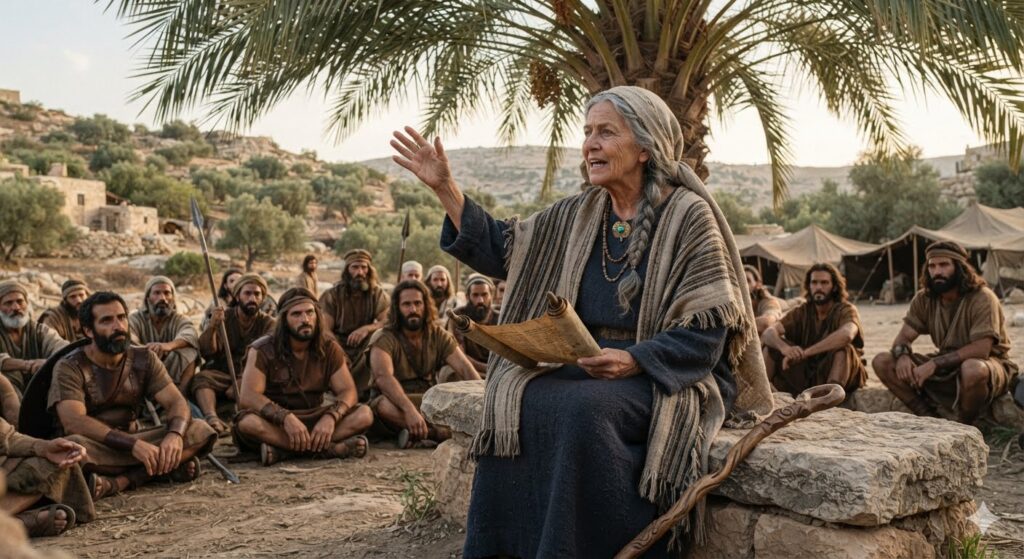
The primary verses about the prophetess Deborah are found in Judges 4 and Judges 5, where she serves as a judge, prophet, and military leader in ancient Israel.
.
Introduction and Leadership of Deborah . . .
.
Judges 4:4-5: Introduces Deborah as a prophetess, wife of Lappidoth, and judge who held court under the Palm of Deborah to settle disputes for the people of Israel.
.
Judges 4:6-7: Records her prophetic command to Barak to gather 10,000 men at Mount Tabor to fight the Canaanite army, promising God’s victory.
.
Judges 4:8-9: Barak asks Deborah to go with him; she agrees but prophesies that the honor of defeating the enemy commander Sisera will go to a woman. (Barak does not ever want to go into battle without Deborah who builds his self-confidence).
.
Judges 4:14: Deborah urges Barak forward into battle, declaring, “This is the day the Lord has given Sisera into your hands.”
.
The Song of Deborah . . .
.
Judges 5:6-7: Reflects on the dark time of oppression before she rose up as “a mother in Israel”.
.
Judges 5:12: Her famous call to action: “Wake up, wake up, Deborah! Wake up, wake up, break out in song! Arise, Barak!”
.
RUTH THE MOABITE
.
The Book of Ruth portrays Ruth’s loyalty to her native Israel, her embrace of God, and her inclusion in the lineage that leads to King David, Jesus, and the royal line of Israel. This story gives forth the promise of God’s presence in marriage between two people of Faith.
.
Ruth’s Vows of Loyalty and Integration . . .
Ruth 1:16: Ruth commits herself to Naomi, her Israelite mother-in-law, saying, “Do not urge me to leave you or to turn from following you. For wherever you go, I will go, and wherever you live, I will live; your people will be my people, and your God will be my God.”
.
Ruth 2:12: Boaz acknowledges Ruth’s choice to leave her homeland, praying, “The Lord repay you for what you have done, and a full reward be given you by the Lord, the God of Israel, under whose wings you have come to take refuge!”
.
The Lineage and Restoring the House of Israel Through the Awesome Ruth . . .
.
Ruth 4:11-12: The elders and people at the city gate bless Boaz and Ruth, praying that she becomes like Rachel and Leah, “who together built up the house of Israel,” and that offspring through her make his family famous.
.
Ruth 4:14-17: The neighborhood women praise God for providing a redeemer to Naomi and note that Ruth “who loves you and who is better to you than seven sons has given him birth,” leading to the birth of Obed, the grandfather of King David.
.
JUDITH, WHOSE GRIT AND CLEVERNESS PROTECTS ISRAEL FROM ASSYRIA
.
The primary passages detailing Judith’s saving of Israel are found in the Book of Judith (part of the Catholic and Orthodox Biblical Apocrypha). Her prayer, the assassination of the Assyrian general Holofernes, and the subsequent victory are recorded across chapters 9, 13, and 16.
.
Judith’s Prayer for Deliverance . . .
.
Judith 9:8–10: Judith asks God to break the enemy’s strength and crush their arrogance “by the hand of a woman”.
.
Judith 9:14: She pleads for God to show the whole world that He alone protects Israel.
.
The Killing of Holofernes by Judith . . .
.
Judith 13:7–8: In the enemy tent, Judith prays for strength, takes down Holofernes’ sword, and strikes his neck twice to cut off his head.
.
Judith 13:14–15: Returning to her town of Bethulia, she displays the head and proclaims that the Lord struck down the enemy by a woman’s hand.
.
Israel’s Victory Because of Judith and Thanksgiving . . .
.
Judith 15:9–10: The leaders of Israel praise Judith, declaring her the glory of Jerusalem and the great pride of Israel.
.
Judith 16:1–5: Judith leads all the people of Israel in a powerful song of thanksgiving and praise to God for their deliverance.
.
.
ESTHER, JEWISH QUEEN OVER MEDEAN PERSIA
.
The primary verses regarding Queen Esther saving the Jewish people (often referred to in the text as their being the Jews who had found themselves collected together in Persia during the Persian diaspora rather than being the restored greater post-exile Israel itself) span several key moments of crisis, resolve, and reversal in the Book of Esther.
.
Esther Understands the Threat to Israel and Her Call to Action . . .
.
Esther 3:13: Haman’s decree to annihilate the Jewish population sets the life-or-death conflict in motion.
.
Esther 4:13–14: Mordecai challenges Esther to use her royal position for her people’s salvation, featuring the iconic “for such a time as this” phrase.
.
Esther 4:15–16: Esther resolves to risk her life by approaching the king unsummoned, asking her people to fast with her.
.
The Reversal From Doom and Deliverance Because of Esther . . .
.
Esther 7:3–4: Esther reveals her identity to King Ahasuerus and pleads for her life and the lives of her people.
.
Esther 7:6-10: Esther’s loyalty toward her people and her respect for the rule of her kingly husband expose the wickedness of Haman, who, despite pleading for his life, is executed on the 75-foot scaffolding that he had intended for the Jews.
.
Esther 8:8: The king authorizes a new decree allowing the Jews to defend themselves, written by Esther and Mordecai.
.
Esther 9:1: The turning point is affirmed, where the anticipated doom of the Jews is reversed, allowing them to overcome their enemies.
.
Yes, the turning point in the life of a person suffering from “gender dysphoria” will happen through the work of God, Who has given us His Son, the Lamb, by Whose Blood we are saved, and His Word, Whose teachings deliver the afflicted. Click NEXT.