WHY WE DO NOT ORDAIN WOMEN TO THE OFFICES OF THE CHURCH
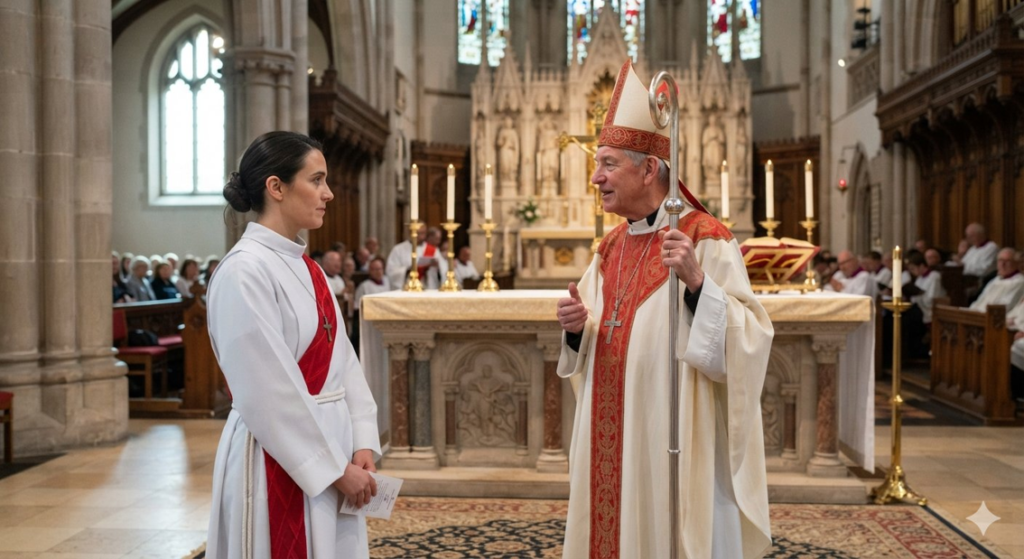
THE REV. DR. RONALD MOORE, the Vicar of Saint Luke’s Anglican Church in Corinth, Mississippi, has written and compiled this superb decretal on behalf his church’s Primate’s Council. TACA commends its irresistible conclusions, which exemplify both everlasting Biblical Truth and ageless Anglican Formularies.
INTRODUCTION: The question of women’s ordination is not peripheral but central to the integrity of the apostolic faith and order. While affirming the equal dignity and worth of women as image-bearers of God, the Church has no authority to ordain them to the sacred Offices of deacon, presbyter, or bishop. This conviction arises not from cultural bias but from fidelity to the pattern given by Christ, received by the Apostles, and maintained by the universal Church through nearly two millennia.
BIBLICAL FOUNDATION: Christ’s Deliberate Example: Our Lord Jesus Christ elevated women in a society that often marginalized them: He spoke with the Samaritan woman at the well (John 4:7–26), allowed women to follow Him as disciples (Luke 8:1–3), and entrusted the first proclamation of the Resurrection to Mary Magdalene (John 20:11–18). Yet when He chose His Apostles, the foundation of the ministerial priesthood, He selected only men (Luke 6:12–16). This cannot be dismissed as cultural accommodation, for Christ routinely defied cultural conventions when they obscured the will of God.
APOSTOLIC TEACHING: The Apostles continued this pattern. St. Paul affirms that men and women share equally in salvation and status before God (Gal. 3:28), yet he distinguishes their roles in the Church’s life. He prohibits women from exercising authoritative teaching or governing over men in the assembly (1 Tim. 2:12–14; 1 Cor. 14:33–35). Moreover, in the Pastoral Epistles, the qualifications for presbyters and bishops assume male incumbency: each must be “the husband of one wife” (1 Tim. 3:2; Titus 1:6).
TYPOLOGICAL ORDER: The ministerial priesthood is typologically ordered to Christ, the Bridegroom, who gives Himself for His Bride, the Church (Eph. 5:25–32). In sacramental ministry, the priest acts in persona Christi capitis—in the person of Christ the Head. This spousal symbolism, grounded in Scripture, necessitates a male priesthood.
THE WITNESS OF TRADITION: Patristic Consensus: From the earliest centuries, the Church ordained only men to the threefold ministry. While women served with distinction as martyrs, prophets, monastics, and teachers, they were never admitted to sacramental office. St. John Chrysostom observed, “The divine law indeed has excluded women from the ministry of the altar” (Homily on 1 Timothy 2). St. Augustine likewise upheld this order, recognizing that the apostolic practice was divinely instituted.
THE QUESTION OF DEACONESSES: Some sources, such as the Apostolic Constitutions, refer to “deaconesses.” However, these women were not ordained to the diaconate as a sacramental office but consecrated to service—primarily ministering to women in baptism and in works of charity. The ordained diaconate has always been male, in continuity with apostolic practice.
THE UNDIVIDED CHURCH: For over nineteen centuries, East and West alike maintained a male-only ordination. The innovations of the late twentieth century—first among Protestants and later in parts of Anglicanism—represent a rupture from the continuous witness of the one, holy, catholic, and apostolic Church.
THEOLOGICAL CONSIDERATIONS: Sacramental Representation: The priesthood is not merely functional but sacramental. The priest represents Christ the Head and Bridegroom in His relation to the Church. Because Christ was incarnate as male, the priest must be male to sacramentally signify that reality. This does not imply superiority of men over women, but fidelity to the sacramental sign established by God.
CREATION AND COMPLEMENTARITY: Men and women are equal in essence but distinct in vocation. This complementarity is woven into the fabric of creation itself (Gen. 1:27; 2:18–24). To deny this order is to obscure God’s design. The exclusion of women from ordained ministry, therefore, does not deny their gifts but affirms divine economy.
AUTHORITY OF THE CHURCH: The Church cannot alter the form of ministry instituted by Christ and His Apostles. As the Anglican Formularies declare, “It is not lawful for the Church to ordain anything that is contrary to God’s Word written” (Article XX). To ordain women would be to exceed the Church’s authority and risk invalidating the sacramental ministry entrusted to her.
PASTORAL SENSITIVITY: Women have always exercised indispensable roles in the life of the Church. The Blessed Virgin
Mary, the first and greatest of the saints, is honored above all. Women such as St. Macrina, St. Monica, and countless others have strengthened the Church through holiness, teaching, and service. In our own day, women continue to exercise vital ministries in education, hospitality, evangelism, and spiritual formation. Their exclusion from the ordained priesthood is not a denial of vocation but an affirmation of God’s appointed order for the Church’s sacramental life.
CONCLUSION
The refusal to ordain women to the Offices of the Church rests on clear biblical testimony, unbroken apostolic tradition, and sound theological reasoning. It is not a concession to culture but an act of obedience to Christ and fidelity to the faith once delivered to the saints. The Church must guard this deposit, not innovate upon it. In so doing, we honor Christ the Bridegroom, preserve the sacramental integrity of His Body, and uphold the divine order established from the beginning.
THE ABOVE WAS WRITTEN The Rev. Dr. Ronald Moore on behalf of the Primate’s Council of Saint Luke’s Anglican Church in Corinth, Mississippi.
The Ecclesiastical Ecumenical Province of TACA, which is a Christian and orthodox Nicene interdenominational Synod administered by the Northeast Diocese of Traditional Anglican Church of America (EEP/NE-TACA) provides a Free Divinities and Theological Education and Basic Certification in Ministry for every kind of future minister. A new minister having attained this certification can opt to accept the offering of (as applicable) ordination, appointment, incardination, or commission at TACA and/or bring this certification to any other traditionalist church or denomination. That Church/Denomination thus also may decide to opt to recognize and to entitle this new minister for its own customs. It is a loving gift by TACA toward gathering together in His Name. Please fill out the below form and/or click NEXT.
280