
THE PRIEST OR MINISTER IS A GODLY PERSON WHO INSPIRES GOODNESS AND WORTHINESS IN THE CONGREGATION
.
“Beloved, I wish above all things that thou mayest prosper and be in health, even as thy soul prospereth” (3 John 1:2).
.
The Minister pursues peace and happiness for his or her church people.
.
“Not forsaking the assembling of ourselves together, as the manner of some is; but exhorting one another: and so much the more, as ye see the day approaching” (Hebrews 10:25).
.
The Minister brings the brethren closer to each other by modeling Grace and quiet virtue.
.
“Wherefore comfort yourselves together, and edify one another, even as also ye do” (1 Thessalonians 5:11).
.
“Let us therefore follow after the things which make for peace, and things wherewith one may edify another” (Romans 14:19).
.
Every person of authority in the Church must increase others’ dignity by being highly moral.
.
“Let every one of us please his neighbour for his good to edification” (Romans 15:2).
.
“Let no corrupt communication proceed out of your mouth, but that which is good to the use of edifying, that it may minister grace unto the hearers” (Ephesians 4:29).
.
“Blessed is the man that walketh not in the counsel of the ungodly, nor standeth in the way of sinners, nor sitteth in the seat of the scornful. But his delight is in the law of the Lord; and in his law doth he meditate day and night. And he shall be like a tree planted by the rivers of water, that bringeth forth his fruit in his season; his leaf also shall not wither; and whatsoever he doeth shall prosper” (Psalm 1:1–3).
.
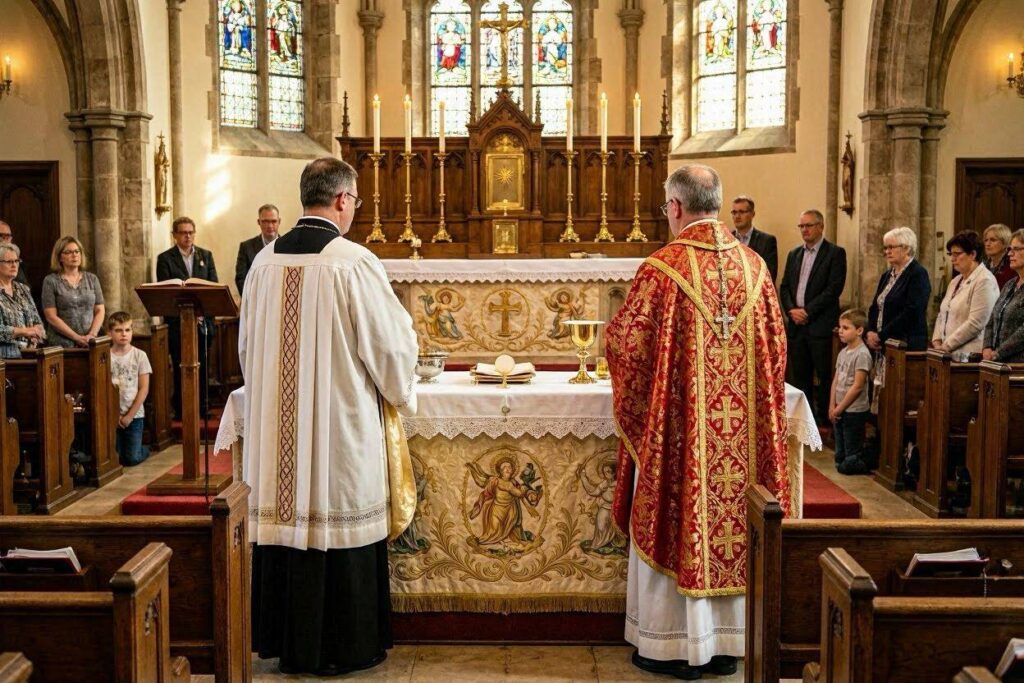
The Consecration and disbursement of the Bread and Wine, and the consumption of the Eucharist by the communicants, require that both the Priest and the Congregation be set apart, resisting living a life of carnal and wrathful temptation.
“Wherefore whosoever shall eat this bread, and drink this cup of the Lord, unworthily, shall be guilty of the body and blood of the Lord” (1 Corinthians 11:27).
.
“’Be attentive! Holy things are for the holy!,’ the congregation replies, ‘One is Holy, One is the Lord, Jesus Christ.’ For One is truly holy, by nature holy; we too are holy, but not by nature, only by participation, and discipline, and prayer (Catechetical [Mystagogical] Lectures; Saint Cyril of Jerusalem; Lec.23: On the Sacred Liturgy and Communion; A.D 345).
.
Being Free of Mortal Sin, in a State of Grace
.
The primary Hebrew word for holy or set apart is qadosh (קָדוֹשׁ), used as an adjective, or the related noun qodesh (קֹדֶשׁ), meaning “set-apartness” or “sacredness”. The showbread is explicitly called lechem kodesh (“holy bread” or “hallowed bread”) in 1 Samuel 21:4. In this passage, the priest Ahimelech tells David that he has no ordinary (chol) bread on hand, but only the lechem kodesh, which he can give to David and his men only because they have kept themselves separate from women.
.
The Nazarites, who were an ascetic religious order, to which Samuel the Prophet, Samson the Judge, and Saint John the Baptist belonged, is defined in the Book of Numbers:
.
“Speak unto the children of Israel, and say unto them, When either man or woman shall separate themselves to vow a vow of a Nazarite, to separate themselves unto the Lord: He shall separate himself from wine and strong drink, and shall drink no vinegar of wine, or vinegar of strong drink, neither shall he drink any liquor of grapes, nor eat moist grapes, or dried. All the days of his separation shall he eat nothing that is made of the vine tree, from the kernels even to the husk. All the days of the vow of his separation there shall no razor come upon his head: until the days be fulfilled, in the which he separateth himself unto the Lord, he shall be holy, and shall let the locks of the hair of his head grow. All the days that he separateth himself unto the Lord he shall come at no dead body. He shall not make himself unclean for his father, or for his mother, for his brother, or for his sister, when they die: because the consecration of his God is upon his head. All the days of his separation he is holy unto the Lord” (Numbers 6:2-8).
.
Again, there are these words from that Apostolic Father, whose life ended in the jaws of the lions whom he had coaxed into completing his martyrdom, in the arena of Rome:
.
“I have no taste for corruptible food nor for the pleasures of this life. I desire the bread of God, which is the flesh of Jesus Christ, who was of the seed of David; and for drink I desire his blood, which is love incorruptible” (Letter to the Romans; Saint Ignatius of Antioch; Chapter 7; Sec. 3; A.D. 110).