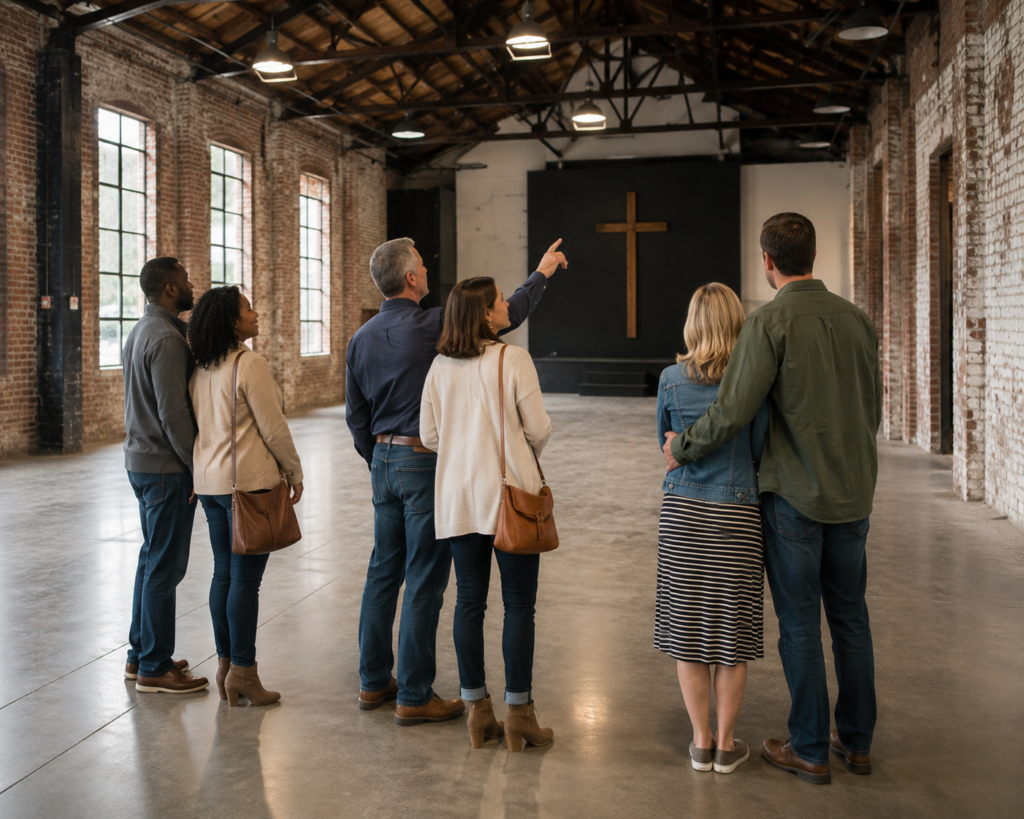
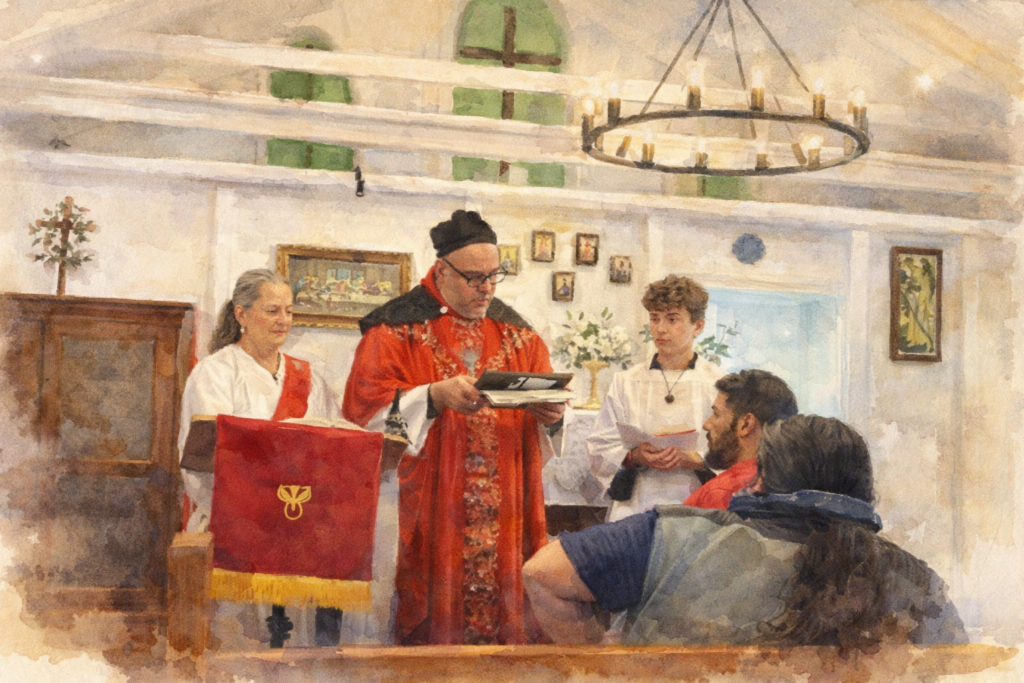
WE CAN HELP YOU SELECT A STRUCTURE, OR HELP MAKE YOUR HOME OR OTHER STRUCTURE INTO A CHURCH. THEN WE’LL COME BLESS IT
Our Bishops Sanctify and Consecrate New and Established Traditional Churches
.
All new independent churches are either seeking to join an established Diocese or are wanting to remain autocephalous, stay non-Denominational, or just be home churches. In every situation, as God is endlessly revealed to the Christian heart, church leaders never keep Truth locked inside themselves. The Apostle Saint Peter taught that Truth indeed does not originate from one’s imagination, when he wrote that prophecy is not of private interpretation. Instead, the inspiration to create a church comes from God as the people who are thus set apart as being Holy are drawn together and moved by the Holy Spirit (2 Peter 1:20).
.
The Northeast Diocese of Traditional Anglican Church of America (NE-TACA) will not only ordain you but dispatch a Bishop to witness your new church and offer to make it part of NE-TACA or bless it. In any case, he will give you, your church, and your congregation and all its ministries instant membership in the interdenominational Synod known as the Ecclesiastical Ecumenical Province (EEP), a purely membership-based theological Diocese. EEP, besides being educational and a Fellowship-driven confraternity, manifests the principle that Christians are united by what is “believed everywhere, always by all.”
.
Please review the content under each of the three buttons below, for each word in the term, “Ecclesiastical Ecumenical Province.” Read how all churches and Christians can get together under this Fellowship arm of the Nicene Creed.
UNIVERSALITY: "Moreover, in the Catholic Church itself, all possible care must be taken, that we hold that faith which has been believed everywhere, always, by all. For that is truly and in the strictest sense "Catholic," which, as the name itself and the reason of the thing declare, comprehends all universally. This rule we shall observe if we follow universality, antiquity, consent. We shall follow universality if we confess that one faith to be true, which the whole Church throughout the world confesses; antiquity, if we in no wise depart from those interpretations which it is manifest were notoriously held by our holy ancestors and fathers; consent, in like manner, if in antiquity itself we adhere to the consentient definitions and determinations of all, or at the least of almost all priests and doctors." (Commonitory; For the Antiquity and Universality of the Catholic Faith Against the Profane Novelties of All Heresies; Saint Vincent of Lérins; Chap. 2; Sec. 6; A.D. 434)
ECUMENICAL CHURCH: You and your church must believe in: 1) The Holy Trinity; 2) Water Baptism; 3) the Nicene Creed of the Incarnation, the Hypostatic Dyophysite Union of God and Jesus (as the Son is both man and God) being One in the same, the Homoousios Consubstantiality of the Same Substance of God, the Son, and the Holy Spirit; 4) Be of orthodox conservative traditional Christendom (e.g., that marriage is between a man and woman only, that only men can be ordained as priests, deacons, and bishops, that the Bible is Truth, that the Word of God was made flesh and dwelt among us, died on the Cross, rose, ascended, and will come again to judge and save us; 5) that we are saved only by the Blood of the Lamb and not by anything in us, from us, around us, doings from us---only by Christ; 6) that the saints are indeed alive and in Communion with us, but only God, Christ, and the Holy Spirit may receive our prayers; 7) that Salvation is available to anyone who believes, repents, and lays down his/her sinful nature and will to be redeemed by the Blood; 8) that innumerable items of differentness the First Seven Ecumenical Councils and the Seven Sacraments (especially the Bible Sacraments of Baptism and the Eucharist), the Filioque, and the celebrations of Christmas, Easter, American Thanksgiving, and Christ-endowed national holidays will never be argued to be articles of contention between churches because our similarities as churches and people of Christ outnumber our differences in countless ways; 9) that no minister, such as a Bishop, Metropolitan, or Pope may lord his authority over all other denominations but that each church system may operate independently by custom of its own self and under the subsidiarity of its leadership type whom it independently chooses for itself in the form of, say, an episcopate, presbytery, council, or home operation.
INTERDENOMINATIONAL PROVINCE: A regional assembly of traditional churches in the form of an oral-covenant framework. This consensus-driven verbal governance protocol contains, like any "convocation" would hope to have it, all the conservative churches possible, within the Catholic, Orthodox, Methodist, Lutheran, and Anglican traditions, along with all their hierarchies, dioceses, parishes, missions, and presbyteries, but coexisting under a verbal-alignment schematic to coexist as equals with eternal and countless commonalities. The trust-indexed executive accord at hand is the Bible's all-encompassing theology. Hence, a setting organized by the timeless pledge-anchoring of the Nicene Creed, which needs no terrestrial jurisdiction, nor any physical hierarchical dominion, the orthodoxy and catholicity of our being each Christian has no offices to be held by incumbents such as overseeing bishops, metropolitans, patriarchs, popes, or any centrality such as a "first among equals," but only the titles already known within each Christian's church, such as "minister" or "priest" or "deacon." Christianity as such is merely administrated in the sheer abstract of increasing everyday interdenominational communication and operates with as-wanted physical in-person get-togethers that are loved best as sheer colloquies between Christian able ministers of the Word . Each Christian recognizes one another by his or her Love for the Trinity and each other. The altar-sharing or prayerful fellowships that can happen within its "borders" are sheerly a matter of kindness shared between churches behaving to uphold the promise of being good and dear and soulful toward one another. Truly---it is also definitively an automatic "mission field," from which churches can freely recruit new ministers, including ones who have been educated by it (NE-TACA). A home, newer, or smaller church would especially benefit from belonging to such a Province, whereas older larger churches would benefit because the Province offers a refreshing outlook and avenue to enjoy new ideas and relationships. The "metropolitan" or "founder" of this Province is its secretary and administrator, Bishop Mike DellaVecchia of the Northeast Diocese of Traditional Anglican Church of America (NE-TACA).
“Except the LORD build the house, they labour in vain that build it: except the LORD keep the city, the watchman waketh but in vain” (Psalm 127:1).