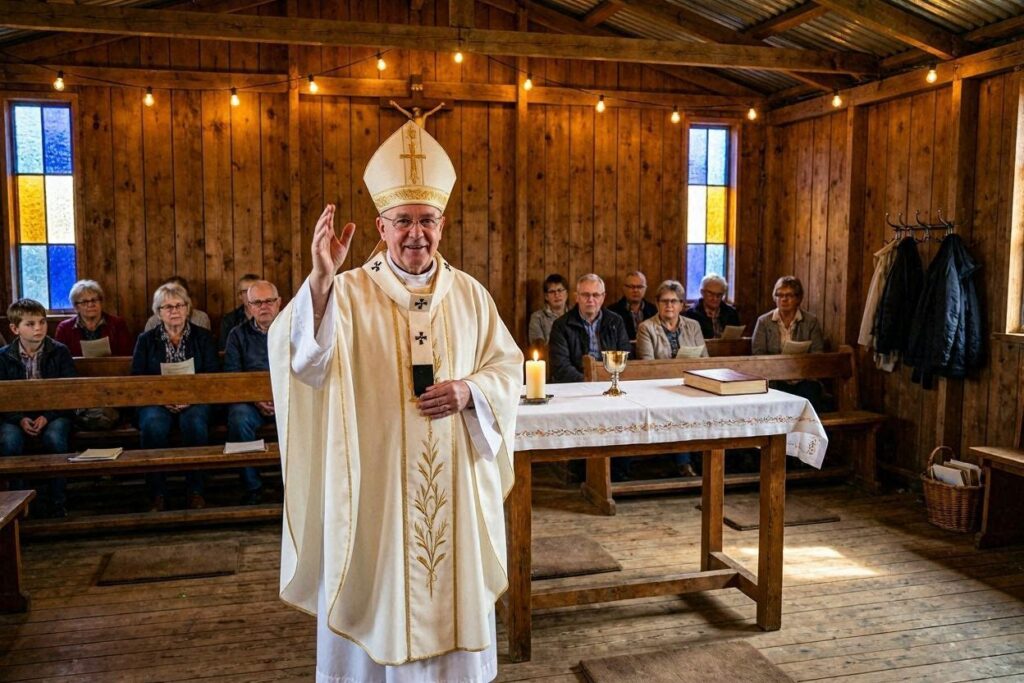
THE CHURCH AS IT EXPRESSES ITS NICENE FULLNESS WITH ECUMENISM AND WHY THIS ECCLESIASTICAL-ECUMENICAL PROVINCE OF
NE-TACA HELPS EXPRESS IT
How Is EEP an Interdenominational Touchpoint That Paraphrases, Via its Existence, the Actualization of “Orthodox and Catholic Church”?
.
The Oral Covenant of the Province
The Ecclesiastical-Ecumenical Province (EEP) manifests as an assembly of all traditional churches taking the form of an oral-covenant framework. It defines itself and Ecumenism as being the Fellowship Arm of the Nicene Creed.
.
A Free-Movement Latitude Polity Activated by Voice
Itself being a consensus-driven verbal governance protocol (as God spoke the world into existence), EEP contains, like any “convocation” would hope to have it, room for all the traditional-Christian churches in existence, all morally orthodox conservative houses of God within the Catholic, Orthodox, Methodist, Lutheran, and Anglican denominations, along with all their hierarchies, dioceses, parishes, missions, and presbyteries, while coexisting under a verbal-alignment schematic to coexist as equals with eternal and countless commonalities, within the theological-dialogue agreement that is True Ecumenism. As God spoke the world into existence, His Word and our shared re-voicing of It, produces the Church.
.
A Spoken-Memorandum of Understanding
This trust-indexed executive accord is, at hand, merely the eternal state of the Bible’s all-encompassing catholicity. Hence, an unchanging setting of permanent orthodoxy organized by the timeless pledge-anchoring of the Nicene Creed itself, this EEP needs no terrestrial jurisdiction, nor any physical hierarchical dominion. In simple terms, the orthodoxy and catholicity of our being each Christian able ministers of God’s Word who nurture our own churches requires no offices to be held by any inter-church incumbents.
.
Intra-Oversight Only
No overseeing bishops, metropolitans, patriarchs, popes, nor any central governor such as a “first among equals” overseeing any fiduciary and ecclesiological management is necessary. Just each church’s intra-church incumbents shepherd over their individual jurisdictions solely, such as bishops and presbyters. Each church is filled only with the titles already known within each Christian’s church, such as “minister” or “priest” or “deacon.” This state of easily yoked, non-burdening True Ecumenism, is what and how the Orthodox Church was hoped to remain, in easy unity, since the moment of Pentecost. Plus, fun. Kids. Food. Prayer.
.
A Vocalized Stakeholder Accord
Christianity as such is instantiated by presenting a universal state that is forever administrated as the sheer abstract of increasing everyday interdenominational communication between Christian able ministers of the Word: It is, as the Bible is, and as Love is, the Truth that Love is God (1 John 4:16) and that we enjoy as a churches Agape unity. Let’s just be together.
.
Nothing in Writing. Totally Theology-Based
Zero written concordats or covenants except between individual churches or denominations. No property co-owned. The only documentation is the Bible. The only canons are the moral laws of Moses and Christ. No paranoia. No jealousies. Just Faith.
NICENE THEOLOGY OF THE EUCHARIST IN ECUMENISM
Christians know that Holy Communion is celebrated in churches everywhere, every Sunday. God sees us as one family in the many mansions of His House (John 14:2). Moreover, in all Christendom we are seen by Him as collecting together to participate with Him in the Reciprocal Indwelling/Perichoresis. This is our Triune God’s indwelling within us of the interpenetration of the Three Persons of the Trinity, substantiated during Holy Communion (περιχώρησις, עִמָּנוּ אֵל משותף מקום; John 14:20; 17:21-23; 1 John 4:13).
.
Holy Communion is our sacrificing of our lives to Christ, viewable through our mutual and individual professed Oblation (προσφορά , קָרְבָּן תְּרוּמָה) during Mass, which is our voiced bloodless offering of ourselves, presented at the altar of every church, issuing aloud the promise of Faith and obedience, oaths shared with one another, the Priest, and God–in and of God, the Son, the Holy Ghost, and our hearts, minds, bodies, spirits, intellect and will (i.e., the indwelling).
.
The Christian Mass, therefore contains our shared Theoria (θεωρία, הִתְבּוֹנְנוּת), which is our participation through the Liturgy of the Word and our mutual oblation at the receipt of the Holy Communion. Mass, understood by all Christians is the gift for us to emulate the Propitiation of Jesus, our Salvation by this Lamb, Whose Body and Blood that saves us, is shared with us through the Eucharist, throughout all of traditional Ecclesia (Luke 23:48; 2 Corinthians 3:18).
.
It is by the sharing with the Priest the Bread and Wine during Holy Communion of the Anamnesis (ἀνάμνησις, זִכָּרוֹן), meaning the divine remembrance of His Passion, Resurrection, and Ascension that the Mass gives us our mutual Epiclesis (ἐπίκλησις, שֶׁפַע). This means the divine outpouring or invocation or the calling-upon of the Holy Spirit when the Bread and Wine are consecrated as the Real Presence. It is by our consuming this Eucharist that Christians continue in God’s transformative work in us that was begun at our Baptisms, our almighty Theosis (θέωσις, דבקות), which is our becoming One with the Trinity. Theosis is a feat fully achieved at our Salvation, at which time we will join together, as we do now, through baptized-Eucharistic church life, but thereafter in Heaven in oneness, Theosis, with the Trinity forever.
.
Getting Together for Easy-Going Colloquial Synods
Ecumenical-minded, this Ecclesiastical Ecumenical Province, calling out to traditional Churches anywhere, thus operates upon lands everywhere, hosting as many as-wanted physical in-person get-togethers that can be made possible. These are events that are cherished as being sheer colloquies of fun and laughter, children and families, old and new friends, for Christ’s sake, organized and announced by Christian Able Ministers of the Word.
.
Each Christian of the traditional Church simply recognizes one another by his or her Love for the Trinity and with Agape for each other, posting notices of meetups on social networking and via e-mail, as the watchful public recognizes the same Parrhesia (boldness, παρρησία, בְּטָחוֹן) that was shown by the Apostles, servants of Christ being themselves, calling all others in their regional vocal mannerisms and Galilean accents to worship Christ, and for all the Apostles to meet and witness Jesus (Acts 4:13).
.
The altar-sharing or prayerful fellowships that can happen with Ecumenism’s/EEP’s encouragement are sheerly a matter of Agape Love manifested between churches who are behaving to uphold the promise of being good and dear and soulful toward one another, joining Christ in getting one another “up yonder” more assuredly to Heaven.
.
An Oral-Alignment Consensus to Be the Catholic and Orthodox Universal Church Militant
Truly—the “Church,” and therefore EEP, which wears the garment of True Ecumenism, is also definitively an automatic “mission field,” from which traditional churches can freely recruit new ministers. Did Christ forbid the people who had never met Him perform miracles in His Name (Mark 9:38–40; Luke 9:49–50)?
.
EEP offers its bounty to the traditional catholic world, along with the men and women who have been educated by its in-house priest-training group of record (NE-TACA).
.
Whom Does EEP Benefit?
A home, or a newer, or a smaller church would especially benefit from belonging to such a Province, whereas older larger churches would benefit too because the Province thus offers a refreshing outlook and avenue to cultivate new ideas and relationships. More churches, less regulation, freedom to collaborate in Communion means that Ecumenism is for real.
.
Who Operates EEP/NE-TACA?
There is no Bishop, Adjutor, or Monsignor overseeing this feat of Ecumenism. Regarding NE-TACA/EEP, there is a simple “metropolitan” or “founder” of this Province, who is merely its secretary and administrator, Bishop Mike DellaVecchia, who works for his own church, the Northeast Diocese of Traditional Anglican Church of America (NE-TACA).
.
How Does This Ecumenical Province Benefit the Forward-Moving Minister?
Conveniently, a proactive Minister can also take his or her certification to a different church or Denomination, one outside of the churches of TACA and apply to become incardinated or appointed within the Vestry or Rectory there, either to receive the same kind of office you would have been given at NE-TACA (e.g., as a Priest), or a lesser/greater office to which they would deem it more valid and licit to convalidate you. EEP’s twofold connection with them and you would thereupon portray an ongoing friendly Ecclesiastical Ecumenical relationship. From that moment on, hence, the Province and the Church Universal itself would become further substantiated.
.
“Priest Swapping” (gleefully sharing ministers to one another’s altars under a formal Concordat and a Communion that would typically be drawn up mutually) would happen by itelf. Or, the blossoming of a friendship and its Eucharistic reciprocity would grow gradually while just now sharing a happy theological Bible-based Fellowship.
.
Adoption/Rebooting of a Closed Church: When a Nicene-believing church closes and it is not part of EEP/NE-TACA, the Ecclesiastical-Ecumenical Province regards it still to be alive through its Congregation. This Diocese, upon request, will host services in its name, or offer use of its church in Perkasie, Pennsylvania for use by the remnant Congregation acting in the name of their beloved Christian home. Our Ecclesiastical Ecumenical Province (EEP), through its ecclesiastical records, keeps your church alive, chartered by EEP as an actual church within its province. A Bishop cancome and Sanctify the structure that you currently use for it. You can invite its departed Pastor to return. Or, NE-TACA will train you or one of your own flock as its new Rector and Conditionally Consecrate your reborn home anew. Yes, it is still alive, as we ponder, “Is a family not still a family even if its parents have died or its house has burned down?” Through Love, Hope, and Faith, EEP makes it so.
.
Formation of New Churches: Those congregations and missions which are just starting out, planting themselves in living rooms, sheds, buildings, chapels, or finished churches, can receive, from EEP, a Sanctification, and later a Conditional Consecration or a Full Diocesan Consecration by a Bishop or a Priest acting on permission of a Bishop, both of whom would be participants in the Province. The new church or oratory, whose members are invited and free to be trained, certified, ordained, appointed/commissioned or incardinated by EEP/NE-TACA are also free to be trained, certified, ordained, appointed/commissioned or incardinated by any church, Mission, Diocese, or Presbytery, whom it chooses in the Province or anywhere in Trinitarian/Nicene Ecclesia. Remember that this is not a competition, but a way for the universal church to grow and cultivate people to lead and teach flocks.
.
Ecumenism Not Needing a Bishop Over Other Bishops and Dioceses
.
There is no need for a “first among equals,” as stated earlier. Who have long ago said this?
.
“But Jesus called them unto him, and said, Ye know that the princes of the Gentiles exercise dominion over them, and they that are great exercise authority upon them. But it shall not be so among you: but whosoever will be great among you, let him be your minister; And whosoever will be chief among you, let him be your servant” (Matthew 20:25-27).
.
“For neither does any of us set himself up as a bishop of bishops, nor by tyrannical terror does any compel his colleague to the necessity of obedience; since every bishop, according to the allowance of his liberty and power, has his own proper right of judgment, and can no more be judged by another than he himself can judge another” (The Seventh Council of Carthage; Saint Cyprian of Carthage; Opening Address: Concerning Validity of Baptism of Heretics; Paragraph 1; September 1, A.D. 256).
.
“Not for that we have dominion over your faith, but are helpers of your joy: for by faith ye stand” (2 Corinthians 1:24).
.
“Wherever there is a bishop, whether it be at Rome or at Engubium, whether it be at Constantinople or at Rhegium, whether it be at Alexandria or at Zoan, his dignity is one and his priesthood is one. Neither the command of wealth nor the lowliness of poverty makes him more a bishop or less a bishop. All alike are successors of the apostles” (Letter 146: The Epistle to Evagrius; Saint Jerome; Paragraph 1; d. A.D. 420).
.
“Feed the flock of God which is among you, taking the oversight thereof, not by constraint, but willingly; not for filthy lucre, but of a ready mind; Neither as being lords over God’s heritage, but being examples to the flock. And when the chief Shepherd shall appear, ye shall receive a crown of glory that fadeth not away. Likewise, ye younger, submit yourselves unto the elder. Yea, all of you be subject one to another, and be clothed with humility: for God resisteth the proud, and giveth grace to the humble” (1 Peter 5:2-5).
.
SUMMARY OF THE ECCLESIOLOGY OF THIS ECUMENICAL PROVINCE:
.
EEP is an Interdenominational agreement that paraphrases, via the existence of the definition of Ecumenism, the actualization of Orthodoxy and Catholicism as defining the Identity of the True Church, out of which Fellowship and Communion grow prominently.
.
EEP expresses the Nicene fullness of the Church with True Ecumenism so that this Ecclesiastical Ecumenical Province can express it well.
.
DEFINITION OF ECUMENISM:
.
True Ecumenism identifies as the “Church” those traditional-Christian churches which:
- Are Catholic, which means the Vincentian Canon, “the belief in the same things at all time and everywhere”
- Are Morally Conservative, that marriage is between man and woman solely, that only men may be ordained and consecrated, obeying the Decalogue and the Moral Laws of Christ and Moses, etc.
- Nicene-Creed professing.
- Belief in the Holy Trinity.
- Belief in Baptism by Water.
- Belief in the Bible as inerrant.
- Salvation solely by Blood of the Lamb.
- Belief in the Eucharist, the Bread and Wine, consecrated as the consubstantive Real Presence—just as our “Faith is the substance of things hoped for, the evidence of things not seen” (Hebrews 11:1).
- Belief in the Seven Sacraments, with that of Baptism and Holy Communion being the two Bible sacraments
- Abiding without argumentation or separation the canons of the first Seven Ecumenical Councils and the as-named Council of Jerusalem.
- Promise not to dispute over the differences between doctrines of EEP churches, knowing that as Traditional Christians, we have far more things in common from which to grow than we have differences about which to argue…
• The International Communion for Anglican-Orthodox
Ecumenical Dialogue: A bilateral assembly between the Anglican Communion
and the Ecumenical Patriarchate of Constantinople to build a shared vision of
Faith, address ethical and moral challenges, and overcome historical divisions.
.
Yes, the TACA Training Is Free . . .
We and our families, along with our congregations and missions, have been bought and paid for by Jesus at a great price. Be educated and serve the Church. Buy the land and build your church. Our seeing a greater and holier universal church is the result that we want in return.
.
“And the king said unto Araunah, Nay; but I will surely buy it of thee at a price: neither will I offer burnt offerings unto the Lord my God of that which doth cost me nothing. So David bought the threshing floor and the oxen for fifty shekels of silver. And David built there an altar unto the Lord, and offered burnt offerings and peace offerings. So the Lord was intreated for the land, and the plague was stayed from Israel” (2 Samuel 24:24-25).
THE ECCLESIOLOGY OF THE ECCLESIASTICAL-ECUMENICAL PROVINCE:
If after reading this summary and praying about it, you decide that you agree with this idea, please send an e-mail to Bishop Mike DellaVecchia of the Northeast Diocese of Traditional Anglican Church of America (EEP/NE-TACA). He will record you as a participant in this Province. His e-mail address is [email protected]
ABSTRACT: The Ecclesiastical Ecumenical Province is an Interdenominational agreement to share Fellowship between churches and denominations that paraphrases, via the eternal truth of the definition of Real Ecumenism, the actualization of Orthodoxy and Catholicism as defining the Identity of the True Church with all its mansions. It is out of a mutually agreed-upon definition of Real Ecumenism of the True Church that Fellowship and Communion can grow prominently so that many people can become Christians or renew their lapsed Christian Faith, and join our churches with extraordinary catechesis and the training the forms Able Ministers of the Word of God. Real Ecumenism grows churches as a safe sense of togetherness, and confidence. We meet together as a “Provincial Synod” not as formal assemblies, but as colloquial get-togethers with ministers and their families and friends. It is within this happy and free environment that the good business of the Church can grow wonderful things. Here then, is the definition of Ecumenism.
DEFINITIONS OF ECUMENISM, INTERDENOMINATIONAL PROVINCE, AND ORAL-BINDING AUTHORITY:
True Ecumenism identifies itself as the “Church,” all those Traditional-Christian churches that:
- Are Catholic, which is the Vincentian Canon, “the belief in the same things at all time and everywhere”
- Are Morally Conservative, knowing biblically that Holy Matrimony is between man and woman solely, that only men may be ordained and consecrated, obeying the Decalogue and the Moral Laws of Christ and Moses, etc.
- Nicene-Creed professing.
- Belief in the Holy Trinity.
- Belief in Baptism by Water.
- Belief in the Bible as inerrant.
- Salvation solely by Blood of the Lamb.
- Belief in the Eucharist, the Bread and Wine, consecrated as the consubstantive Real Presence
- Belief in the Seven Sacraments, with that of Baptism and Holy Communion being the two Bible sacraments
- Abiding without argumentation or separation the canons of the first Seven Ecumenical Councils and the Council of Jerusalem (Acts 15).
- Promise not to dispute over the differences between doctrines of EEP churches, knowing that as Traditional Christians, we have far more things in common from which to grow than we have differences about which to argue.
Ruling: The Ecclesiastical-Ecumenical Province holds it to be true that True Ecumenism is that where Traditional Christians exemplify heartfully the above elements they are modeling and expressing the Nicene fullness of the Church.
The Oral Covenant of an Ecumenical Province
The Ecclesiastical-Ecumenical Province (EEP) manifests itself as an assembly of all traditional churches taking the form of an oral-covenant framework. It defines itself and Ecumenism as being the Fellowship Arm of the Nicene Creed.
A Free-Movement Latitude Polity Activated by Voice
Itself being a consensus-driven verbal governance protocol (as God spoke the world into existence), EEP contains, like any “convocation” would hope to have it, room for all the traditional-Christian churches in existence, all morally orthodox conservative houses of God within the Catholic, Orthodox, Methodist, Lutheran, and Anglican denominations, along with all their hierarchies, dioceses, parishes, missions, and presbyteries, while coexisting under a verbal-alignment schematic to coexist as equals with eternal and countless commonalities, within the theological-dialogue agreement that is True Ecumenism. As God spoke the world into existence, His Word and our shared re-voicing of It, produces the Church.
A Spoken-Memorandum of Understanding
This trust-indexed executive accord is, at hand, merely the eternal state of the Bible’s all-encompassing catholicity. Hence, an unchanging setting of permanent orthodoxy organized by the timeless pledge-anchoring of the Nicene Creed itself, this EEP needs no terrestrial jurisdiction, nor any physical hierarchical dominion. In simple terms, the orthodoxy and catholicity of our being each Christian able ministers of God’s Word who nurture our own churches requires no offices to be held by any inter-church incumbents.
Intra-Oversight Only
No overseeing bishops, metropolitans, patriarchs, popes, nor any central governor such as a “first among equals” overseeing any fiduciary and ecclesiological management is necessary. Just each church’s intra-church incumbents shepherd over their individual jurisdictions solely, such as bishops and presbyters. Each church is filled only with the titles already known within each Christian’s church, such as “minister” or “priest” or “deacon.” This state of easily yoked, non-burdening True Ecumenism, is what and how the Orthodox Church was hoped to remain, in easy unity, since the moment of Pentecost. Plus, fun. Kids. Food. Prayer.
A Vocalized Stakeholder Accord
Christianity as such is instantiated by presenting a universal state that is forever administrated as the sheer abstract of increasing everyday interdenominational communication between Christian able ministers of the Word: It is, as the Bible is, and as Love is, the Truth that Love is God (1 John 4:16) and that we enjoy as a churches Agape unity. Let’s just be together.
Nothing in Writing. Totally Theology-Based
Zero written concordats or covenants except between individual churches or denominations. No property co-owned. The only documentation is the Bible. The only canons are the moral laws of Moses and Christ. No paranoia. No jealousies. Just Faith.
NICENE THEOLOGY OF THE EUCHARIST IN ECUMENISM:
Christians know that Holy Communion is celebrated in churches everywhere, every Sunday. God sees us as one family in the many mansions of His House (John 14:2). Moreover, in all Christendom we are seen by Him as collecting together to participate with Him in the Reciprocal Indwelling/Perichoresis. This is our Triune God’s indwelling within us of the interpenetration of the Three Persons of the Trinity, substantiated during Holy Communion (περιχώρησις, עִמָּנוּ אֵל משותף מקום; John 14:20; 17:21-23; 1 John 4:13).
Holy Communion is our sacrificing of our lives to Christ, viewable through our mutual and individual professed Oblation (προσφορά , קָרְבָּן תְּרוּמָה) during Mass, which is our voiced bloodless offering of ourselves, presented at the altar of every church, issuing aloud the promise of Faith and obedience, oaths shared with one another, the Priest, and God–in and of God, the Son, the Holy Ghost, and our hearts, minds, bodies, spirits, intellect and will (i.e., the indwelling).
The Christian Mass, therefore contains our shared Theoria (θεωρία, הִתְבּוֹנְנוּת), which is our participation through the Liturgy of the Word and our mutual oblation at the receipt of the Holy Communion. Mass, understood by all Christians is the gift for us to emulate the Propitiation of Jesus, our Salvation by this Lamb, Whose Body and Blood that saves us, is shared with us through the Eucharist, throughout all of traditional Ecclesia (Luke 23:48; 2 Corinthians 3:18).
It is by the sharing with the Priest the Bread and Wine during Holy Communion of the Anamnesis (ἀνάμνησις, זִכָּרוֹן), meaning the divine remembrance of His Passion, Resurrection, and Ascension that the Mass gives us our mutual Epiclesis (ἐπίκλησις, שֶׁפַע). This means the divine outpouring or invocation or the calling-upon of the Holy Spirit when the Bread and Wine are consecrated as the Real Presence. It is by our consuming this Eucharist that Christians continue in God’s transformative work in us that was begun at our Baptisms, our almighty Theosis (θέωσις, דבקות), which is our becoming One with the Trinity. Theosis is a feat fully achieved at our Salvation, at which time we will join together, as we do now, through baptized-Eucharistic church life, but thereafter in Heaven in oneness, Theosis, with the Trinity forever.
Getting Together for Easy-Going Colloquial Synods
Ecumenical-minded, this Ecclesiastical Ecumenical Province, calling out to traditional Churches anywhere, thus operates upon lands everywhere, hosting as many as-wanted physical in-person get-togethers that can be made possible. These are events that are cherished as being sheer colloquies of fun and laughter, children and families, old and new friends, for Christ’s sake, organized and announced by Christian Able Ministers of the Word.
Each Christian of the traditional Church simply recognizes one another by his or her Love for the Trinity and with Agape for each other, posting notices of meetups on social networking and via e-mail, as the watchful public recognizes the same Parrhesia (boldness, παρρησία, בְּטָחוֹן) that was shown by the Apostles, servants of Christ being themselves, calling all others in their regional vocal mannerisms and Galilean accents to worship Christ, and for all the Apostles to meet and witness Jesus (Acts 4:13).
The altar-sharing or prayerful fellowships that can happen with Ecumenism’s/EEP’s encouragement are sheerly a matter of Agape Love manifested between churches who are behaving to uphold the promise of being good and dear and soulful toward one another, joining Christ in getting one another “up yonder” more assuredly to Heaven.
An Oral-Alignment Consensus to Be the Catholic and Orthodox Universal Church Militant
Truly—the “Church,” and therefore EEP, which wears the garment of True Ecumenism, is also definitively an automatic “mission field,” from which traditional churches can freely recruit new ministers. Did Christ forbid the people who had never met Him perform miracles in His Name (Mark 9:38–40; Luke 9:49–50)?
.
EEP offers its bounty to the traditional catholic world, along with the men and women who have been educated by its in-house priest-training group of record (NE-TACA).
Whom Does EEP Benefit?
A home, or a newer, or a smaller church would especially benefit from belonging to such a Province, whereas older larger churches would benefit too because the Province thus offers a refreshing outlook and avenue to cultivate new ideas and relationships. More churches, less regulation, freedom to collaborate in Communion means that Ecumenism is for real.
Who Operates EEP/NE-TACA?
There is no Bishop, Adjutor, or Monsignor overseeing this feat of Ecumenism. Regarding NE-TACA/EEP, there is a simple “metropolitan” or “founder” of this Province, who is merely its secretary and administrator, Bishop Mike DellaVecchia, who works for his own church, the Northeast Diocese of Traditional Anglican Church of America (NE-TACA).
How Does This Ecumenical Province Benefit the Forward-Moving Minister?
Conveniently, a proactive Minister can also take his or her certification to a different church or Denomination, one outside of the churches of TACA and apply to become incardinated or appointed within the Vestry or Rectory there, either to receive the same kind of office you would have been given at NE-TACA (e.g., as a Priest), or a lesser/greater office to which they would deem it more valid and licit to convalidate you. EEP’s twofold connection with them and you would thereupon portray an ongoing friendly Ecclesiastical Ecumenical relationship. From that moment on, hence, the Province and the Church Universal itself would become further substantiated.
“Priest Swapping” (gleefully sharing ministers to one another’s altars under a formal Concordat and a Communion that would typically be drawn up mutually) would happen by itelf. Or, the blossoming of a friendship and its Eucharistic reciprocity would grow gradually while just now sharing a happy theological Bible-based Fellowship.
Adoption of Closed Church: When a Nicene-believing church closes and it is not part of EEP/NE-TACA, the Ecclesiastical-Ecumenical Province regards it still to be alive through its Congregation. This Diocese, upon request, will host services in its name, or offer use of its church in Perkasie, Pennsylvania for use by the remnant Congregation acting in the name of their beloved Christian home. Our Ecclesiastical Ecumenical Province (EEP), through its ecclesiastical records, keeps your church alive, chartered by EEP as an actual church within its province. A Bishop cancome and Sanctify the structure that you currently use for it. You can invite its departed Pastor to return. Or, NE-TACA will train you or one of your own flock as its new Rector and Conditionally Consecrate your reborn home anew. Yes, it is still alive, as we ponder, “Is a family not still a family even if its parents have died or its house has burned down?” Through Love, Hope, and Faith, EEP makes it so.
Blessing/Anointing of New Churches: Those congregations and missions which are just starting out, planting themselves in living rooms, sheds, buildings, chapels, or finished churches, can receive, from EEP, a Sanctification, and later, a Conditional Consecration or Full Diocesan Consecration by a Bishop or a Priest acting on permission of a Bishop, both of whom would be participants in the Province. The new church or oratory, whose members are invited and free to be trained, certified, ordained, appointed/commissioned or incardinated by EEP/NE-TACA are also free to be trained, certified, ordained, appointed/commissioned or incardinated by any church, Mission, Diocese, or Presbytery, whom it chooses in the Province or anywhere in Trinitarian/Nicene Ecclesia. Remember that this is not a competition, but a way for the universal church to grow and cultivate people to lead and teach flocks.
Ecumenism’s Not Needing a Bishop Over Other Bishops and Dioceses
There is no need for a “first among equals,” as stated earlier. Who have long ago said this?
“But Jesus called them unto him, and said, Ye know that the princes of the Gentiles exercise dominion over them, and they that are great exercise authority upon them. But it shall not be so among you: but whosoever will be great among you, let him be your minister; And whosoever will be chief among you, let him be your servant” (Matthew 20:25-27).
“For neither does any of us set himself up as a bishop of bishops, nor by tyrannical terror does any compel his colleague to the necessity of obedience; since every bishop, according to the allowance of his liberty and power, has his own proper right of judgment, and can no more be judged by another than he himself can judge another” (The Seventh Council of Carthage; Saint Cyprian of Carthage; Opening Address: Concerning Validity of Baptism of Heretics; Paragraph 1; September 1, A.D. 256).
“Not for that we have dominion over your faith, but are helpers of your joy: for by faith ye stand” (2 Corinthians 1:24).
“Wherever there is a bishop, whether it be at Rome or at Engubium, whether it be at Constantinople or at Rhegium, whether it be at Alexandria or at Zoan, his dignity is one and his priesthood is one. Neither the command of wealth nor the lowliness of poverty makes him more a bishop or less a bishop. All alike are successors of the apostles” (Letter 146: The Epistle to Evagrius; Saint Jerome; Paragraph 1; d. A.D. 420).
“Feed the flock of God which is among you, taking the oversight thereof, not by constraint, but willingly; not for filthy lucre, but of a ready mind; Neither as being lords over God’s heritage, but being examples to the flock. And when the chief Shepherd shall appear, ye shall receive a crown of glory that fadeth not away. Likewise, ye younger, submit yourselves unto the elder. Yea, all of you be subject one to another, and be clothed with humility: for God resisteth the proud, and giveth grace to the humble” (1 Peter 5:2-5).
Biblical Authority to be a Province:
The Ecclesiastical-Ecumenical Province is a Theoretical Provincial Provisional Non-Competitive Non-Conflicting Ecclesiastical Theological Jurisdiction defined solely by the Bible. As Christ built the Church upon the Rock of Faith (Matthew 16:18), Jesus has told us to gather together (Matthew 18:20). He has called us forward to make disciples of all nations (Matthew 28:19); Christ, with the Holy Ghost, has purchased the church with His own Blood and made us overseers (Acts 20:28); and, the Son of God has told us to encourage each other never to stop meeting together, as the Day or Year of our Lord approaches (Hebrews 10:24-25; Isaiah 61:2; Zephaniah 1:14).
What is Ecclesiastical Provinciality in Ecumenism?
A church province is an intermediate governing layer between an individual diocese and the broader national or universal or catholic Church structure. In orthodox and other tradition it is fleshed out by smaller dioceses, or suffragans, and overseen by a Primate or Senior Elder, such as a Metropolitan Archbishop. Such structures function as unified multi-denominational synods, with a Ecumenical Synod and/or sometimes with regional synods. While denominations historically maintain separate governance, several regional and global models integrate bishops and elders across distinct church bodies.
Examples of Ecumenical Provinces and Synods
- The Porvoo Communion: An agreement linking Anglican and Lutheran churches across Europe. While not a single administrative province, Porvoo effectively creates a shared ecumenical space where bishops from multiple national denominations (e.g., the Church of England and the Church of Sweden) participate in one another’s synods and consecrations.
- Churches Uniting in Christ (CUIC): This U.S.-based ecumenical movement brings together several denominations (including The Episcopal Church, the United Methodist Church, and the Presbyterian Church [USA]) with the goal of functioning as a visible, shared community. Members formally recognize each other’s ministries and collaborate on shared regional governance.
- The Ecumenical Catholic Communion (ECC): This is a distinct, independent denomination that utilizes an intentionally synodal model of governance. It integrates the episcopal and presbyteral (elder) traditions of Catholic and Orthodox polities with democratic, multi-denominational representation. Its central Synod consists of a House of Bishops collaborating with elected Houses of Pastors and Laity.
- The Anglican-Roman Catholic International Commission (ARCIC): While an ongoing theological dialogue rather than a governing province, ARCIC has produced consensus documents exploring how a unified global synod could function with a universal primate and regional bishops across both traditions.
- The International Communion for Anglican-Orthodox Ecumenical Dialogue: A bilateral assembly between the Anglican Communion and the Ecumenical Patriarchate of Constantinople to build a shared vision of Faith, address ethical and moral challenges, and overcome historical divisions.
- Local Ecumenical Partnerships (LEPs): Also, on a localized level, denominations often form formal ecumenical parishes or synods, particularly in the United Kingdom and parts of North America. In these arrangements, bishops and elders from multiple traditions (such as Methodists and Anglicans) minister together in a single shared congregation or district, governed by a unified regional council.
Are There any Examples in any Particular Church’s Canon Law of Church Provinciality?
Yes. Because a Province is a jurisdiction shared by two or more dioceses, the concept of an Ecclesiastical Province ought to have a canonical precedent about churches sharing ecclesiastical power equally. Thus, by removing the mandate for oversight by a senior Bishop, such as a “Pope,” the Provisional status to use this model not only becomes helpfully parallel with how the Roman Catholic Church has actually written canons for Provinciality, but which for achieving reasonable polity, makes the ecclesiology fair and equitable:
In the Roman Catholic Church, Canon 431 of the Code of Canon Law mandates grouping neighboring dioceses into “ecclesiastical provinces” to promote common pastoral action.
- Canon 440 allows the bishops of these provinces to convene a “provincial council” (or provincial synod) to legislate and address regional needs.
- Canon 431: Defines the ecclesiastical province with lawful meaning. It groups adjacent dioceses together so bishops can collaborate on regional pastoral initiatives, share resources, and maintain closer relationships.
- Canon 440: Grants the authority to celebrate a Provincial Council or Synod. When the majority of diocesan bishops in a province determine it is opportune for the church’s mission, they can convene this council or synod to address specific local circumstances and make regional legislative decisions.
- Juridical Personality: By virtue of Canon 432 itself, an ecclesiastical province that exists under this Roman canon law possesses “rights” and responsibilities that cannot be violated by any conflicting or competitive man or group.
- Christ as Sole Bishop: Moreover, as Colossians 2:20-23 explains, there are no “doctrines of men” applying to everyone universally that can be found in laws written by men. In the ancient orthodox-catholic church, that is, these legal “rights” were instead known as the Dominion, which belonged solely to each Primary Diocese within the province.
The Helpfulness of the Doctrine of In Persona Episcopi (i.e., Jurisdictions Sharing a Bishop)
The appointment of one Bishop or Senior Presbyter to participate in two separate jurisdictions who already share a Concordat (e.g., participating in Holy Communion together) signifies the concept of In Persona Episcopi. It is a practical application of the universal authority of the Church to freely appoint Bishops or Senor Presbyters to other principalities and establish the pastoral governance of the particular churches of each, as outlined in Canon 377 §1 and Canon 413 by the Roman Catholic Church, which for Christendom’s actual catholic purposes are extraordinary standards whose truths do not need the authority of a Supreme Pontiff to actualize, because Christ is the true head of the Church.
The Canonical Mechanics of In Persona Episcopi
- Canon 377 §1: This canon establishes that a cathedral or senior church body has the sovereign authority to freely appoint bishops, or to confirm those who have been legitimately elected.
- Canon 413: In situations where two dioceses are united in persona episcopi, this canon provides the canonical mechanism. It allows a single Bishop to be appointed as the Ordinary (the Diocesan Bishop) for multiple distinct dioceses.
Why the Status Remains Separate, of Each Party Within In Persona Episcopi
Under the In Persona Episcopi arrangement, the cathedral or senior church of a Diocese or Archdiocese or Presbytery creates a personal union of the pastoral office rather than a legal merger of the dioceses themselves. The dioceses retain completely separate distinguishable legal identities. They maintain distinct administrative structures, including separate cathedrals, financial assets, seminaries, diocesan curias (staff), and canonical tribunals.
How the Ancient Church Expressed “Non-Competitive” and “Non-Conflicting”:
- The Council of Nicaea (A.D. 325): Canon 6 famously mandated: “Let the ancient customs prevail,” specifically citing the authority of the bishops in Alexandria, Rome, and Antioch over their respective surrounding regions.
- The Council of Constantinople (A.D. 381): Canon 2 further restricted the jurisdiction of bishops to their specific provinces, forbidding them from interfering with churches outside of their established boundaries.
- The Council of Chalcedon (A.D. 451): Is historically famous for its 27 disciplinary and administrative canons that restricted overreach by wandering bishops. Specifically, Canons 9 and 17 mandated that bishops and metropolitans retain total authority over their regional dioceses without meddling in the affairs of other jurisdictions.
The Council of Chalcedon’s Standards of Churches’ Autonomy
These localized authority principles of Chalcedon were codified into several key tenets of canon law:
- Jurisdictional Independence: Bishops were instructed to manage their own regional churches and historically established traditions.
- Canon 17 of Chalcedon prohibited any Bishop from arrogantly intervening or holding authority in the diocese of another bishop.
- Local Appeals and Clergy Discipline: Canon 9 established that if clergy members had disputes with their bishop, they must appeal to their regional metropolitan or the local synod. It decentralized the final arbitration power to regional metropolitan authorities rather than external, competing jurisdictions.
- Monastic Authority: Canon 4 placed monasteries and clergy strictly under the authority of the Bishop in their local city, forbidding monks from acting arrogantly against their own Bishop. For our uses, no “Arius” or a Gnostic philosopher like Valentinus may rationally stand up and overtake an ecclesiastic region or regions.
- Rejection of Jurisdiction Splitting: Canon 12 of Chalcedon prohibited civil authorities from dividing single church provinces in order to artificially elevate a new Metropolitan’s jurisdictional authority. This is useful when noting the lack of Scriptural authority for a new upstart Oliver Cromwell to invoke nationwide Christian laws, or a new General William Booth to turn dioceses into new Salvation Armies.
Biblical Roundup Words:
We and our families, along with our congregations and missions, have been bought and paid for by Jesus at a great price. Be educated and serve the Church. Buy the land and build your church.
“And the king said unto Araunah, Nay; but I will surely buy it of thee at a price: neither will I offer burnt offerings unto the Lord my God of that which doth cost me nothing. So David bought the threshing floor and the oxen for fifty shekels of silver. And David built there an altar unto the Lord, and offered burnt offerings and peace offerings. So the Lord was intreated for the land, and the plague was stayed from Israel” (2 Samuel 24:24-25).
SUMMARIES OF THE FIRST SEVEN ECUMENICAL COUNCILS (INCLUDING THE JERUSALEM COUNCIL)
The first Seven Ecumenical councils recognized by the traditional Church produced a combined total of 137 individual disciplinary canons across their sessions (and an additional 102 from an important regional Synod). Because writing out the complete legal text for all 137 provisions would be excessively long, they are designated below by their standard numbers and traditional descriptive names/summaries. For full unabridged texts, consult collections like the Nicene and Post-Nicene Fathers.
- Council of Jerusalem in Acts 15 (A.D. 48–50).
The Apostles and Disciples, led by saints James, Peter, and Paul decided that Gentile believers did not need to follow Jewish laws, such as circumcision, to be saved. They only asked them to avoid idols, sexual sin, blood, and meat from strangled animals.
- The Problem: Some men from Judea told non-Jewish believers they must be circumcised to be saved.
- The Debate: Paul and Barnabas argued with these men. They went to Jerusalem to talk to the apostles and elders.
- Peter’s Speech: Peter reminded the group that God gave the Holy Spirit to the Gentiles too, without requiring Jewish laws.
- Paul and Barnabas: They shared stories of how God worked miracles among the Gentiles.
- James’ Decision: James suggested a letter be sent to Gentile believers to avoid heavy burdens, with a few basic rules.
The Final Rules
- Do not eat food offered to idols.
- Do not commit sexual sin.
- Do not eat the meat of strangled animals.
- Do not eat blood.
- First Council of Nicaea (A.D. 325) — 20 Canons
The First Ecumenical Council of Nicaea in A.D. 325 did not issue separate “homoousian” or “hypostatic” canons. Instead, it produced a single set of 20 disciplinary canons regulating church order, alongside the Nicene Creed which defined the homoousios (consubstantiality) of the Son. The Ncaea council used the term homoousios in its primary creed to define the Son as “of one substance” (homoousion tō Patri) with the Father, proving His full divinity against Arianism. Its 20 canons deal strictly with clerical discipline, lapsi, and hierarchy, containing zero uses of the word.
The 20 Canons of Nicaea
- Canon 1: Prohibits men who castrated themselves from entering the clergy, while allowing those castrated by illness or barbarians to remain.
- Canon 2: Forbids rushing new heathen converts into immediate ordination as priests or bishops without proper testing.
- Canon 3: Forbids clergy from housing unrelated young women who could cause suspicion, permitting only close relatives like mothers or sisters.
- Canon 4: Recommends that a bishop be appointed by all bishops in the province, or at least by three with written consent from the rest.
- Canon 5: States that excommunications by one bishop must be respected by others, but provides for a provincial synod review twice a year.
- Canon 6: Confirms ancient patriarchal and metropolitan customs and regional jurisdictions for Alexandria, Rome, and Antioch.
- Canon 7: Grants special honorary precedence to the Bishop of Aelia (Jerusalem) while keeping metropolitan rights for the local province.
- Canon 8: Sets terms for the reconciliation of the Cathari (Novatians) returning to the Catholic and Orthodox Church.
- Canon 9: Declares that priests ordained without proper examination or who confess past sins should be deposed.
- Canon 10: Disqualifies lapsed Christians (lapsi) who were mistakenly ordained out of ignorance.
- Canon 11: Imposes penance on those who apostatized during the persecution of Licinius without facing actual danger.
- Canon 12: Imposes penance on military supporters of the tyrant Licinius who fought against Christians.
- Canon 13: Permits giving the Eucharist (viaticum) to excommunicated persons facing imminent death.
- Canon 14: Sets penance requirements for catechumens who lapsed during persecution.
- Canon 15: Forbids bishops, priests, and deacons from moving from city to city (transferring between sees).
- Canon 16: Prohibits clerics from leaving their assigned church or being ordained in another diocese without permission.
- Canon 17: Forbids members of the clergy from lending money at interest or taking usury.
- Canon 18: Reminds deacons of their subordinate role relative to bishops and priests.
- Canon 19: Sets strict rules for the readmission and rebaptism/reception of followers of Paul of Samosata.
- Canon 20: Mandates that prayers on Sundays and during Pentecost (the Paschal season) be offered while standing rather than kneeling.
- First Council of Constantinople (A.D. 381) — 7 Canons
The Second Ecumenical Council was held in A.D. 381 in First Council of Constantinople. It promulgated four core disciplinary canons universally recognized by the Orthodox and Catholic Church (with canons 5–7 added by a subsequent regional Synod in A.D. 382). While it defined the homoousian and hypostatic theology of the Trinity against Arian and Macedonian heresies, its enacted canons are administrative and disciplinary rather than numbered dogmatic formulas.
The Canons of the Second Ecumenical Council
- Canon 1: The Preservation of the Nicene Faith and Condemnation of Heresies
Decrees that the Nicene Creed of A.D. 325 must remain inviolate. It explicitly anathematizes the Eunomians, Anomoeans, Arians (Eudoxians), Semi-Arians (Pneumatomachi), Sabellians, Marcellians, Photinians, and Apollinarians. - Canon 2: Diocesan Boundaries and Non-Interference
Prohibits bishops from traveling outside their designated dioceses or interfering in neighboring churches. It mandates that the Bishop of Alexandria manage Egypt alone, the bishops of the East manage the East alone, and respects the internal governance of the Asian, Pontic, and Thracian dioceses. - Canon 3: The Rank of Constantinople
Grants the Bishop of Constantinople (New Rome) the prerogative of honor directly after the Bishop of Old Rome, because Constantinople is the new imperial capital. - Canon 4: The Condemnation of Maximus the Cynic
Declares that Maximus the Cynic was never a legitimate bishop, that any ordinations performed by him are null and void, and that he holds no rank in the
- Canon 5: Acceptance of the Western tome regarding the consubstantiality of the Trinity.
- Canon 6: Restrictions and regulations on bringing formal accusations against bishops.
- Canon 7: Method of receiving various classes of heretics into the Church (via baptism or anathema). Note: Canon 7 is sometimes indexed differently or omitted in some ancient Western registers.
- Council of Ephesus (A.D. 431) — 8 Canons
The Third Ecumenical Council (Ephesus, 431 AD) promulgated eight formal canons concerning ecclesiastical discipline, the defense of the Nicene Faith, and the condemnation of Nestorianism and Pelagianism. While its profound Christological definitions regarding the hypostatic union, the homoousios, and the title Theotokos are expressed primarily in its approval of Saint Cyril’s letters and Twelve Anathemas rather than separate dogmatic numbered canons, the numbered disciplinary canons safeguard these realities.
The Eight Canons of the Council of Ephesus
- Canon 1: Deposition of Metropolitans Who Favor Nestorius or Celestius
- Summary: Any metropolitan bishop who abandons the Ecumenical Synod to join Nestorius or adopt the heresy of Celestius (Pelagianism) loses all authority and communion over his fellow provincial bishops and is degraded from his rank.
- Canon 2: Deposition of Provincial Bishops Who Yield to Apostasy
- Summary: Provincial bishops who failed to attend the holy synod but joined or attempted to join the apostasy of Nestorius—or who signed his deposition and later returned to his camp—are likewise deposed from the priesthood.
- Canon 3: Restoration of Clergy Oppressed for Orthodoxy
- Summary: Clergy in cities or villages who have been suspended or deposed by Nestorius because of their adherence to the orthodox faith are fully restored to their proper rank. Conversely, all clergy are forbidden to obey or collaborate with apostate bishops.
- Canon 4: Deposition of Clergy Subscribing to Nestorianism
- Summary: Any member of the clergy who openly defects and upholds the ungodly and heterodox teachings of Nestorius is subjected to formal deposition from his clerical office.
- Canon 5: Penalties for Clergy Condemned by the Synod
- Summary: Clergymen who have been condemned for uncanonical and unholy behaviors or heretical views by the holy synod are denied any right to re-impose themselves or exercise ministry over other clergy.
- Canon 6: Sanctions Against Those Who Reject the Council’s Decrees
- Summary: Any person—whether bishop, cleric, or layman—who attempts to subvert or ignore the judgments and decrees enacted by the holy Synod at Ephesus faces total forfeiture of office if clerical, or formal excommunication if lay.
- Canon 7: Prohibition of Any New or Rival Creed
- Summary: It is strictly unlawful for anyone to compile, write, or present a creed or “different faith” (heteran pistin) different or rival to that established by the Holy Fathers at Nicaea. Those who draft or introduce alternative creeds to converts from paganism, Judaism, or heresy face deposition (if bishops/clergy) or anathema (if lay). Note: While the canon does not contain the word filioque, Eastern Orthodox theologians and apologists historically invoke this specific Ephesus canon as a legislative barrier against the later insertion of the filioque (“of the son”) clause into the creed by the Latin Church.
- Canon 8: Preservation of Regional Privileges (The Church of Cyprus)
- Summary: Bishops are forbidden to assume control or exercise illegal jurisdiction over provinces that were not historically under their authority from the beginning, guarding against the encroachment of worldly power. This specifically protected the ancient autocephalous rights of the Church of Cyprus against Antioch.
- Council of Chalcedon (A.D. 451) — 30 Canons
The Fourth Ecumenical Council took place in A.D. 451 at Chalcedon. Rather than issuing separate “homoousian” or “hypostatic” canons, the council published 30 disciplinary canons alongside its defining Christological Definition of the Faith (which affirmed Christ’s two natures in one hypostasis). The Chalcedon council explicitly expanded the application of homoousios in its dogmatic definition, stating Christ is homoousios with the Father regarding His divinity, and homoousios with humanity regarding His manhood. Its 30 canons govern monasticism, ordination fees, and city jurisdictions.
The 30 Canons of Chalcedon
- Canon 1: Previous canons of all holy synods must remain in force.
- Canon 2: Banning the buying and selling of church ordinations (simony) and imposing penalties on brokers.
- Canon 3: Forbidding clergy from managing secular business properties or worldly affairs, except when mandated by law for minors or appointed by the bishop for the care of the poor/orphans.
- Canon 4: Submitting monks and rural monasteries to the authority of the local bishop and forbidding them from interfering in secular or church business.
- Canon 5: Restricting clerics from moving between different cities or churches.
- Canon 6: Prohibiting the ordination of “absolute” or unassigned clergy (ordinatio absoluta); every person ordained must be attached to a specific church.
- Canon 7: Forbidding military officers or former civil officials from taking clerical rank or monastic status arbitrarily.
- Canon 8: Requiring clergy of almshouses, monasteries, and chapels to remain under the authority of the bishop of the city.
- Canon 9: Directing that clerical legal disputes must be brought before the local bishop rather than secular courts.
- Canon 10: Forbidding a cleric from being enrolled in the church registers of two different cities at the same time.
- Canon 11: Requiring letters of peace (eulogiae) for the poor and needy when they travel.
- Canon 12: Prohibiting provinces from being divided by imperial rescripts into two metropolises, preserving the true historical metropolitan dignity.
- Canon 13: Shutting out foreign or un-certificated clerics from ministering without letters of recommendation from their own bishop.
- Canon 14: Forbidding lower clergy (cantors or readers) from intermarrying with heretics, and requiring children of such unions baptized elsewhere to be brought into the Catholic Church.
- Canon 15: Setting the minimum age for a deaconess at forty years old, with strict ordination criteria.
- Canon 16: Forbidding consecrated virgins and monks from marrying; breaking this vows incurs excommunication.
- Canon 17: Securing rural parishes (horia) under the jurisdiction of the bishop who has held them for thirty years.
- Canon 18: Declaring the crime of conspiracy or confederacy among clerics or monks to depose or attack bishops completely illegal.
- Canon 19: Requiring provincial synods of bishops to assemble twice a year to examine canonical matters.
- Canon 20: Forbidding bishops from transferring their protected clergy to churches in other cities on their own whim.
- Canon 21: Requiring proper formal proof or accusations before complaints are entertained against a cleric.
- Canon 22: Making it illegal for clerics to seize the goods and property of a deceased bishop after his death.
- Canon 23: Authorizing the expulsion of foreign, wandering, or disruptive clergy and monks from Constantinople by the bishop’s officials.
- Canon 24: Prohibiting the re-secularization of monasteries; once consecrated, a monastery remains a permanent monastic house.
- Canon 25: Mandating that metropolitan bishops must ordain vacant bishopscopies within three months.
- Canon 26: Requiring every bishopric to have an economic administrator (oikonomos) chosen from its own clergy to manage church finances.
- Canon 27: Punishing those guilty of the forcible abduction of women under the guise of marriage.
- Canon 28: Confirming equal privileges and honors for the See of Constantinople (New Rome) alongside Old Rome, stating that Constantinople’s second place in rank matches its status as the imperial capital (noted for initial resistance by the papal legates).
- Canon 29: Prohibiting a bishop from being demoted to the rank of a priest (though a bishop removed for cause can keep a seat in the sanctuary).
- Canon 30: Allowing Egyptian bishops time to sign the Tome of Pope Leo rather than forcing immediate summary deposition.
- Second Council of Constantinople (A.D. 553) — 14 Canons/Anathemas
The Fifth Ecumenical Council (the Second Council of Constantinople in A.D. 553) did not issue any disciplinary or administrative canons. Instead, it focused entirely on dogmatic questions, issuing 14 anathemas (often called chapters or dogmatic decrees) to define orthodox Christology, defend the concept of the homoousian Trinity, and explain the hypostatic union.
Because these are structured as anathemas rather than numbered disciplinary canons, they do not have formal “names,” but they are titled numerically by their doctrinal content regarding the Holy Trinity and the single hypostasis of Christ.
The 14 Dogmatic Anathemas (Canons) of Constantinople II
- Anathema 1 (The Consubstantial Trinity): Rejects anyone who does not confess a single, consubstantial (homoousian) divine nature, power, and godhead in three subsistences or Persons (Father, Son, and Holy Spirit) to be worshipped.
- Anathema 2 (The Two Nativities of the Word): Rejects anyone who does not confess two nativities of the Word of God—one eternal from the Father before all ages, and one temporal from the holy Mother of God, Mary.
- Anathema 3 (The Inseparability of Christ’s Miracles and Passions): Rejects anyone who says that the God-Logos who worked miracles is one person, and Christ who suffered is another, or that God was with the Christ as an extra person.
- Anathema 4 (No Mere Moral Union): Rejects anyone who says the union between the Word of God and man was only a matter of grace, honor, or dignity (as Nestorius claimed), rather than a true union of natures.
- Anathema 5 (The Expression “One Hypostasis”): Rejects anyone who takes the phrase “one person (hypostasis) of our Lord Jesus Christ” to mean a union of multiple hypostases, or who tries to smuggle two hypostases or persons back into Christ.
- Anathema 6 (Mary as Theotokos): Rejects anyone who calls the Holy Virgin Mary Theotokos (Mother of God) in a figurative or false sense, rather than truly and properly because the God-Logos was incarnate of her.
- Anathema 7 (The Two Natures Unconfused yet Undivided): Rejects anyone who uses the expression “in two natures” in a way that separates the Word and the flesh, rather than recognizing a union without confusion (asynchytos) and without separation (adairesetos). The correct term is Dyohysitism.
- Anathema 8 (Rejection of Division or Mixture): Rejects anyone who confesses a union of two natures resulting in one substance or nature, if they mean a mixture or fusion, or if they refuse to acknowledge that the distinction of natures remains unconfused even in the union.
- Anathema 9 (Worship of Christ): Rejects anyone who says Christ is to be worshipped in two natures (implying two objects of worship), rather than a single adoration of the Incarnate Word with His flesh.
- Anathema 10 (Christ as Crucified in the Flesh): Rejects anyone who does not confess that our Lord Jesus Christ who was crucified in the flesh is true God and Lord of Glory, and one of the Holy Trinity.
- Anathema 11 (Condemnation of Arius, Eunomius, Macedonius, et al.): Rejects all heretics who did not hold the true homoousian faith, specifically naming Arius, Eunomius, Macedonius, Apollinaris, Nestorius, and Eutyches.
- Anathema 12 (Condemnation of Theodore of Mopsuestia): Anathematizes Theodore of Mopsuestia, who taught that Christ was a mere man profiting from moral progress separate from the divine Logos.
- Anathema 13 (Condemnation of Diodorus and Theodoret’s Writings): Condemns the impious writings of Diodorus of Tarsus and Theodoret of Cyrrhus directed against Cyril of Alexandria.
- Anathema 14 (Condemnation of Ibas’s Letter): Condemns the letter of Ibas of Edessa which denied that God the Word took flesh from the Virgin Mary.
- Third Council of Constantinople (A.D. 680–681) — No Canons
The Sixth Ecumenical Council (the Third Council of Constantinople, 680–681 AD) did not enact any disciplinary or numerical canons of its own. This council focused entirely on the theological debate regarding Monothelitism (two wills in Christ, divine and human). It promulgated a dogmatic Definition of Faith confirming two wills and two energies (divine and human, or Dyothelitism) in Christ, alongside specific anathemas against Monothelitism
The disciplinary canons associated with the Sixth Ecumenical Council belong instead to the Council in Trullo (Quinisext Council, A.D. 692), which met to supply the missing canons (102 discioplinary rules) for both the Fifth and Sixth Ecumenical Councils. The 102 disciplinary rules are printed at the bottom of this document.
Dogmatic Definition (Not Numbered Canons)
The doctrinal proclamations of the Sixth Ecumenical Council concerning Christ’s two natures, energies, and wills—safeguarding the homoousian reality of His divinity and the hypostatic union of the two wills in the single Person of Christ—are found in its Definition of Faith (Horos) rather than numbered canons:
- The Definition of Faith of Constantinople III: Declares two natural wills and two natural operations (divine and human) in Christ, cooperating without division, change, separation, or confusion, in strict accordance with the hypostatic union defined at Chalcedon.
Disciplinary Canons of the Quinisext Council (Acting as the Canons of the 5th/6th Councils)
The 102 canons of the Council in Trullo ratified the general body of prior canonical law. Notably, Canon 1 of this council formally lists and approves the dogmatic bounds of the previous six ecumenical councils (including Nicaea’s homoousian decrees and Chalcedon/Constantinople III’s hypostatic definitions), binding them into legal force for the Orthodox Catholic Church:
- Canon 1 of the Council in Trullo (Quinisext): Ratifies the faith and decrees of the prior six holy ecumenical synods, rejecting all heresies condemned by them and affirming the complete dogmatic continuity of the Church.
- The additional 101 disciplinary of the Council of Trulio/Quinisext are printed at the bottom of this document.
- Second Council of Nicaea (A.D. 787) — 22 Canons
The Seventh Ecumenical Council (the Second Council of Nicaea, A.D. 787) promulgated 22 disciplinary and reforming canons concerning clerical discipline and monastic order. The council did not draft separate or specialized “homoousian” or “hypostatic” canons; rather, the dogmatic defense of the homoousios (the consubstantial Trinity) and the hypostatic reality of Christ’s incarnate image (veneration of icons) was declared in the central Definition of Faith, while all 22 canons uniformly apply these truths to church life.
The 22 Canons of the Seventh Ecumenical Council
- Canon 1: That the sacred Canons are in all things to be observed (upholding previous canonical tradition, the Apostles, past councils, and the Fathers).
- Canon 2: That bishops must be thoroughly instructed in the Psalter and the canons before consecration, and not be hastily ordained.
- Canon 3: Against the appointment of civil magistrates to ecclesiastical (episcopal) dignities.
- Canon 4: That bishops must not exact money, gifts, or material exactions from their clergy.
- Canon 5: Against bishops or clerics who accuse their superiors falsely or harbor covetousness/nepotism.
- Canon 6: Regarding the yearly holding of metropolitan provincial synods to resolve church matters.
- Canon 7: That converts from Iconoclasm must sign recantations and anathematize the heresy before entering the church.
- Canon 8: Against feigned conversions of crypto-Jews who continue to practice Judaism in secret.
- Canon 9: That all unauthorized books, iconoclastic writings, and pseudepigraphal anti-icon tracts must be surrendered to the episcopate.
- Canon 10: Against clerics who abandon their own diocese to take charge in another without permission (desertion and pluralism).
- Canon 11: That every church, cathedral, and monastery must have its own designated steward (oikonomos) to manage property honestly.
- Canon 12: Against bishops or superiors who alienate, sell, or misuse monastic and church lands for secular/state use.
- Canon 13: Concerning the restoration of episcopal residences, secularized monasteries, and sacred buildings back to church use.
- Canon 14: That unordained persons (not tonsured as readers) are forbidden to read the Epistle or Gospel in the ambo.
- Canon 15: Against clerics holding pluralities of benefices or serving multiple distant churches at once.
- Canon 16: That clergy must wear modest, simple apparel, avoiding sumptuous or vanity-driven clothing.
- Canon 17: That monks must not abandon their monasteries to build independent houses of prayer without proper financial means to finish them.
- Canon 18: That women (other than approved relatives) are forbidden to dwell in bishops’ houses or male monasteries.
- Canon 19: That superiors of churches and monasteries are forbidden to demand money or fees for ordaining or admitting persons to the clerical or monastic state.
- Canon 20: Prohibiting double monasteries (monasteries housing both men and women together).
- Canon 21: That a monk or nun may not leave one convent/monastery to enter another without absolute authorization from the superior.
- Canon 22: Regulating appropriate, decorous behavior and mixed-gender dining among laity and monastics.
Appendix:
The Quinisext Council, commonly called the Council in Trullo (A.D. 692), promulgated exactly 102 disciplinary and administrative canons to complete the work of the Fifth and Sixth Ecumenical Councils. Rather than bearing formal modern titles, the canons are traditionally identified by Roman numerals and summarized by their regulatory focus concerning clerical standards, liturgical uniformity, and moral discipline.
The complete sequential list of the 102 canons of the Council in Trullo covers the following provisions:
- Canon 1: Confession of the orthodox faith of the six ecumenical councils and rejection of heresies.
- Canon 2: Ratification of the 85 Apostolic Canons, previous ecumenical and local councils, and specific patristic letters.
- Canon 3: Condemnation of those who remarry after being in orders or contract uncanonical second marriages.
- Canon 4: Deposition of clerics or excommunication of laymen who corrupt persons dedicated to God.
- Canon 5: Prohibition of priests keeping suspicious women in their households.
- Canon 6: Regulation of subdeacons, deacons, and priests regarding marriage before vs. after ordination.
- Canon 7: Precedence of deacons over presbyters in seating/rank within liturgical settings.
- Canon 8: Requirement for annual provincial synods of bishops.
- Canon 9: Prohibition of clergy harboring murderers or engaging in certain feuds.
- Canon 10: Prohibition of usury by bishops, priests, and deacons.
- Canon 11: Forbidding friendly intercourse, medical use, or bathing with Jews.
- Canon 12: Imposition of mandatory celibacy/continence for bishops.
- Canon 13: Protection of the lawful marriage rights of priests and deacons against enforced separation.
- Canon 14: Ages for ordination to priesthood (30) and diaconate (25).
- Canon 15: Age for ordination of subdeacons (20).
- Canon 16: Regulation on the number of deacons in large cities.
- Canon 17: Prohibition of clerics changing from one church/diocese to another without letters-patent.
- Canon 18: Prohibition of clerics driven from their homes residing elsewhere without permission.
- Canon 19: Obligation of bishops to preach and teach the scriptures and orthodox dogmas.
- Canon 20: Restriction of bishops teaching outside their own jurisdictions.
- Canon 21: Penalties for clerics who commit canonical offenses deserving deposition.
- Canon 22: Deposition of those who buy or sell clerical office (simony).
- Canon 23: Prohibition of charging fees for administering Holy Communion.
- Canon 24: Prohibition of the clergy and monks engaging in horse-racing or theatrical spectacles.
- Canon 25: Deposition of clerics convicted of minor criminal offenses.
- Canon 26: Regulations on second marriages for subdeacons, readers, and singers.
- Canon 27: Rules on clerical dress and appropriate modest behavior.
- Canon 28: Prohibition of eating meat that contains blood.
- Canon 29: Restriction on celebrating the liturgy in private chapels without bishop permission.
- Canon 30: Allowance for priests in barbarian lands to adapt minor local accommodations.
- Canon 31: Prohibition of holding services in private houses by independent presbyters against the bishop.
- Canon 32: Prohibition of mixing water with wine incorrectly during the eucharistic offering (specifically targeting Armenian usage).
- Canon 33: Exclusion of sub-deacons, singers, and readers from wearing the orarion (stole) or performing deacon duties.
- Canon 34: Severe penalties for conspiracies or oaths against bishops and fellow clergy.
- Canon 35: Prohibition of metropolitans seizing the property of deceased bishops.
- Canon 36: Reaffirmation of the ancient ranking order of the sees of Constantinople, Rome, Alexandria, Antioch, and Jerusalem.
- Canon 37: Permission for bishops to remain in office despite barbarian invasions disrupting their sees.
- Canon 38: Maintenance of civil chronological calculations and provincial jurisdictions if altered by the emperor.
- Canon 39: Confirmation of the privileges of the Archbishop of Cyprus residing in New Justiniana.
- Canon 40: Rules governing the foundation and autonomy of monasteries.
- Canon 41: Rules for hermits living in cells before entering public assembly.
- Canon 42: Regulation of unauthorized wanderers dressed as monks.
- Canon 43: Right of all Christians to choose the monastic life.
- Canon 44: Prohibition of monks leaving their monasteries for secular or disorderly pursuits.
- Canon 45: Prohibition of women residing in male monasteries.
- Canon 46: Regulations for female monastics leaving the convent for valid reasons.
- Canon 47: Prohibition of laymen sleeping inside women’s monasteries.
- Canon 48: Requirement for the wife of an elevated bishop to enter a distant monastery.
- Canon 49: Prohibition of converting existing monasteries into secular public lodgings or inns.
- Canon 50: Prohibition of games of chance and gambling by clergy and laity.
- Canon 51: Complete prohibition of theatrical actors, public games, and wild-beast hunts.
- Canon 52: Prohibition of the liturgy of the Presanctified on all days of Lent except Saturdays and Sundays.
- Canon 53: Rules regarding spiritual godparents marrying their spiritual children/widows.
- Canon 54: Prohibition of incestuous and uncanonical marriages.
- Canon 55: Prohibition of fasting on Saturdays and Sundays during Lent (except Holy Saturday).
- Canon 56: Prohibition of eating cheese and eggs on Saturdays and Sundays of Lent.
- Canon 57: Prohibition of offering honey or milk at the altar during the eucharist.
- Canon 58: Prohibition of laymen distributing the eucharist to themselves in the absence of clergy.
- Canon 59: Prohibition of baptisms inside private baptisteries or chapels.
- Canon 60: Restriction on those who pretend to be possessed by demons.
- Canon 61: Excommunication for consulting soothsayers, magicians, or fortune-tellers.
- Canon 62: Prohibition of ancient pagan festivals, Kalends, Bota, and public dancing.
- Canon 63: Prohibition of reciting apocryphal or false martyr histories.
- Canon 64: Prohibition of laymen speaking publicly on theological matters in defiance of church order.
- Canon 65: Prohibition of lighting bonfires in front of houses at new moons.
- Canon 66: Instructions for the spiritual care of the faithful during Easter week.
- Canon 67: Prohibition of corrupting or destroying animals destined for human food unrightfully.
- Canon 68: Prohibition of mutilating, defacing, or destroying ecclesiastical books.
- Canon 69: Prohibition of laymen entering the holy sanctuary (altar area), with an exception for the Emperor.
- Canon 70: Prohibition of women speaking or teaching in church during liturgical assemblies.
- Canon 71: Prohibition of students using secular sophistry or unseemly behavior within schools of the church.
- Canon 72: Prohibition of marriage between an orthodox person and a heretic.
- Canon 73: Prohibition of treating the life-giving cross with disrespect or placing it on the floor.
- Canon 74: Prohibition of turning agape feasts inside churches into secular banquets.
- Canon 75: Prohibition of loud, unseemly shouting and singing corrupting church psalmody.
- Canon 76: Prohibition of setting up taverns or commercial shops within holy church enclosures.
- Canon 77: Prohibition of clerics or monastics bathing publicly with women.
- Canon 78: Requirement for catechumens to learn the faith thoroughly before baptism.
- Canon 79: Prohibition of distributing baptismal gifts in the form of loaves shaped like the cross.
- Canon 80: Deposition of bishops, priests, or deacons absent from their church without cause for three Sundays.
- Canon 81: Prohibition of adding unauthorized phrases to the Trisagion hymn.
- Canon 82: Requirement to depict Christ as a human being rather than symbolically as a Lamb.
- Canon 83: Prohibition of giving the Eucharist to the bodies of the dead.
- Canon 84: Regulation of children’s baptisms and parental responsibility.
- Canon 85: Prohibition of keeping slaves belonging to churches without manumission.
- Canon 86: Deposition of those who keep houses of ill fame or exploit prostitutes.
- Canon 87: Penance for women who abandon their husbands or commit adultery.
- Canon 88: Prohibition of bringing animals into holy churches except in absolute necessity.
- Canon 89: Penance for violating fasts through negligence or contempt.
- Canon 90: Prohibition of kneeling on Sundays and from Saturday evening to Sunday evening (Pentecost season).
- Canon 91: Imposition of the penalty for murder upon women who procure abortions and those who supply the abortifacient drugs.
- Canon 92: Penance for those who abduct women under the pretext of marriage.
- Canon 93: Rules regarding women who consent to abduction.
- Canon 94: Penance for receiving or participating in uncanonical oaths.
- Canon 95: Regulations on the reception of converts from various heresies into the church.
- Canon 96: Excommunication for styling hair or adorning oneself to entice lust.
- Canon 97: Condemnation of cohabitating with persons in unchaste unions within sacred church precincts.
- Canon 98: Deposition for marrying a woman who was already betrothed or married to another.
- Canon 99: Deposition of certain unassigned or vagrant clergy operating without oversight.
- Canon 100: Prohibition of displaying unseemly or scandalous pictures that corrupt the mind.
- Canon 101: Requirement to receive the eucharist with the hands positioned in the form of a cross.
- Canon 102: Pastoral discretion (economia): empowering bishops and priests to weigh the disposition of the sinner and adapt penances remedially rather than rigidly.
CHRISTOLOGY 101 – THE DOGMATIC DEFINITIONS BEHIND THE NICENE, APOSTLE’S, AND ATHANASIUS CREEDS:
The following dogmatic terms articulate the precise Christological Trinitarian vocabulary used in the Ecumenical Councils:
- Hypostasis (one person/individual) comes from hypostasis, meaning “person” or “substantive reality”. The Hypostatic Union teaches that Christ’s two natures are joined in his one single person.
- Homoousian (same substance) means “consubstantial” or “of the same essence/substance” (homos = same, ousia = substance/nature). Thus, the term provides the foundational building block for understanding who Jesus is in relation to God. Homoousian literally means Christ is the exact same divine substance and nature as God, His Father. Jesus is thus fully God.
- Dyophysitism (two natures) means “two natures” (dyo = two, physis = nature). It asserts that Christ has both a fully divine nature and a fully human nature.
- Dyothelitism (two wills): This is the logical next step after dyophysitism. It asserts that because Jesus has two distinct natures (divine and human), he must also have two corresponding wills (a divine will and a human will) that always act in perfect harmony.
- Filioque (Holy Spirit coming from the Son, and not merely from the Father) Thus, being the Third Person of the Trinity, the Holy Spirit exists in Perichoresis (interpenetration) with the Father and the Son. The Bible says that the risen Christ breathed the Holy Spirit into the Apostles (John 20:22). The Johannine Comma (Comma Johanneum) is, by contrast, a short, disputed phrase in 1 John 5:7–8 that explicitly mentions the Trinity (“the Father, the Word, and the Holy Ghost: and these three are one”). Modern textual scholars agree it was not part of the original text, but was added later in Latin manuscripts and made famous by the King James Version. The Filioque was promulgated at the Third Council of Toledo in Spain (589), the Second Council of Lyon (1274), and the Council of Florence (1439)—though these later two councils were rejected by the Eastern Orthodox Church.
How Dyophysitism and Hypostasis Work Together
- The “Two” in Dyophysitism: Christ possesses two complete and unmixed natures—human and divine.
- The “One” in Hypostasis: These two natures coexist within one single divine person or hypostasis.
- The words hypostatic and dyophysitism both describe the orthodox Christian belief about the person and natures of Jesus Christ. Hypostatic refers to one single person (hypostasis), while dyophysitism refers to two distinct natures (divine and human) united in that person. The words hypostatic (from hypostasis, meaning “person” or “subsistence”) and dyophysitism (meaning “two natures”) both describe Jesus Christ.
- The Result: Dyophysitism states what Christ has (two natures), and the hypostatic concept states how they are held together (in one person) without splitting him into two separate individuals.
How Dyophysitism and Hypostasis Relate to the Homoousian
- Homoousian means “consubstantial” or “of the same essence/substance” (homos = same, ousia = substance/nature), being exactly what God is in substance. It was used at the Council of Nicaea to affirm that God the Son is of the exact same divine substance as God the Father.
- The Connection Between Homoousian, Hypostasis, Dyophisitism, and Dyothelitism:
- To be homoousian means the Son shares the identical divine ousia (nature) as the Father.
- Because He is homoousian with the Father, when He became human, He brought that full divine nature into union with human nature (dyophysitism), anchoring both natures safely inside one divine identity (hypostatic union).
- Homoousian defines the identity of His divine nature beforehand, whereas dyophysitism and the hypostatic union define how that divine nature and a newly assumed human nature coexist in one person during the Incarnation.
- These words build on one another, moving from the identity of God (homoousian), to individual persons (hypostasis), to Christ having two natures (dyophysitism), and finally to Christ having two wills (dyothelitism).
How the Concepts Hypostasic Union, Homoousios, Dyophysite, and Dyothelitism Appear in the Ecumenical Councils
While the precise terminology is absent from the numbered canons, the underlying theological concepts are anchored in the historical definitions connected to these specific councils:
- Homoousian (Consubstantial / Same Substance):
- Defined primarily at the First Council of Nicaea (325) and reaffirmed at Constantinople I (381) in the Nicene-Constantinopolitan Creed. It asserts that the Son is of the same divine essence as the Father.
- Hypostatic Union (Union in one Person/Hypostasis):
- Defined at the Council of Chalcedon (451), stating that the two natures of Christ (divine and human) are united in one single person (hypostasis) without confusion or division. Echoed conceptually in the anathemas of Constantinople II (553) regarding the “natural union” (enōsis physikē).
- Dyophysitism (Two Natures):
- Articulated explicitly by the Council of Chalcedon (451), rejecting Eutychian monophysitism by insisting Christ remains in two distinct, complete natures.
- Dyothelitism (Two Wills):
- Defined at the Third Council of Constantinople (680–681), which condemned Monothelitism and affirmed that Christ possesses both a human and a divine will, operating in harmony.
CHRISTOLOGY 101 – THE DOGMATIC DEFINITIONS BEHIND THE NICENE, APOSTLE’S, AND ATHANASIUS CREEDS:
The following dogmatic terms articulate the precise Christological Trinitarian vocabulary used in the Ecumenical Councils:
- Hypostasis (one person/individual) comes from hypostasis, meaning “person” or “substantive reality”. The Hypostatic Union teaches that Christ’s two natures are joined in his one single person.
- Homoousian (same substance) means “consubstantial” or “of the same essence/substance” (homos = same, ousia = substance/nature). Thus, the term provides the foundational building block for understanding who Jesus is in relation to God. Homoousian literally means Christ is the exact same divine substance and nature as God, His Father. Jesus is thus fully God.
- Dyophysitism (two natures) means “two natures” (dyo = two, physis = nature). It asserts that Christ has both a fully divine nature and a fully human nature.
- Dyothelitism (two wills): This is the logical next step after dyophysitism. It asserts that because Jesus has two distinct natures (divine and human), he must also have two corresponding wills (a divine will and a human will) that always act in perfect harmony.
- Filioque (Holy Spirit coming from the Son, and not merely from the Father) Thus, being the Third Person of the Trinity, the Holy Spirit exists in Perichoresis (interpenetration) with the Father and the Son. The Bible says that the risen Christ breathed the Holy Spirit into the Apostles (John 20:22). The Johannine Comma (Comma Johanneum) is, by contrast, a short, disputed phrase in 1 John 5:7–8 that explicitly mentions the Trinity (“the Father, the Word, and the Holy Ghost: and these three are one”). Modern textual scholars agree it was not part of the original text, but was added later in Latin manuscripts and made famous by the King James Version. The Filioque was promulgated at the Third Council of Toledo in Spain (589), the Second Council of Lyon (1274), and the Council of Florence (1439)—though these later two councils were rejected by the Eastern Orthodox Church.
How Dyophysitism and Hypostasis Work Together
- The “Two” in Dyophysitism: Christ possesses two complete and unmixed natures—human and divine.
- The “One” in Hypostasis: These two natures coexist within one single divine person or hypostasis.
- The words hypostatic and dyophysitism both describe the orthodox Christian belief about the person and natures of Jesus Christ. Hypostatic refers to one single person (hypostasis), while dyophysitism refers to two distinct natures (divine and human) united in that person. The words hypostatic (from hypostasis, meaning “person” or “subsistence”) and dyophysitism (meaning “two natures”) both describe Jesus Christ.
- The Result: Dyophysitism states what Christ has (two natures), and the hypostatic concept states how they are held together (in one person) without splitting him into two separate individuals.
How Dyophysitism and Hypostasis Relate to the Homoousios
- Homoousian means “consubstantial” or “of the same essence/substance” (homos = same, ousia = substance/nature), being exactly what God is in substance. It was used at the Council of Nicaea to affirm that God the Son is of the exact same divine substance as God the Father.
- The Connection Between Homoousian, Hypostasis, Dyophisitism, and Dyothelitism:
- To be homoousian means the Son shares the identical divine ousia (nature) as the Father.
- Because He is homoousian with the Father, when He became human, He brought that full divine nature into union with human nature (dyophysitism), anchoring both natures safely inside one divine identity (hypostatic union).
- Homoousian defines the identity of His divine nature beforehand, whereas dyophysitism and the hypostatic union define how that divine nature and a newly assumed human nature coexist in one person during the Incarnation.
- These words build on one another, moving from the identity of God (homoousian), to individual persons (hypostasis), to Christ having two natures (dyophysitism), and finally to Christ having two wills (dyothelitism).
How the Concepts Hypostasic Union, Homoousios, Dyophysite, and Dyothelitism Appear in the Ecumenical Councils
While the precise terminology is absent from the numbered canons, the underlying theological concepts are anchored in the historical definitions connected to these specific councils:
- Homoousian (Consubstantial / Same Substance):
- Hypostatic Union (Union in one Person/Hypostasis):
- Defined at the Council of Chalcedon (451), stating that the two natures of Christ (divine and human) are united in one single person (hypostasis) without confusion or division. Echoed conceptually in the anathemas of Constantinople II (553) regarding the “natural union” (enōsis physikē).
- Dyophysitism (Two Natures):
- Articulated explicitly by the Council of Chalcedon (451), rejecting Eutychian monophysitism by insisting Christ remains in two distinct, complete natures.
- Dyothelitism (Two Wills):
- Defined at the Third Council of Constantinople (680–681), which condemned Monothelitism and affirmed that Christ possesses both a human and a divine will, operating in harmony.