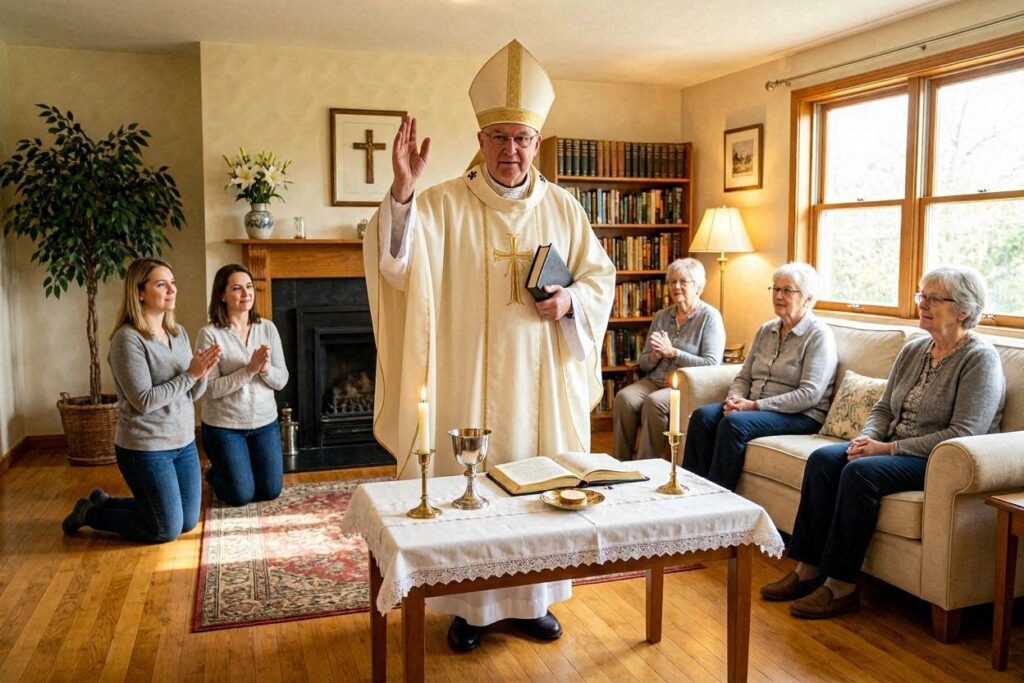
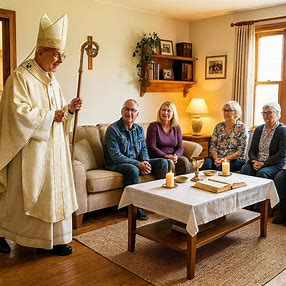
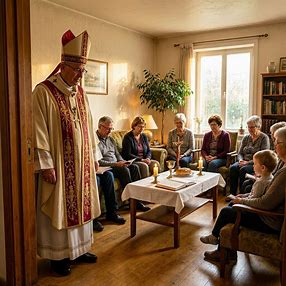
WE CAN BRING A PRIEST OR BISHOP TO SANCTIFY YOUR HOUSE-CHURCH/DIY-CHURCH
.
“Ye also, as lively stones, are built up a spiritual house, an holy priesthood, to offer up spiritual sacrifices, acceptable to God by Jesus Christ” (1 Peter 2:5).
.
Although no formal study yet exists, millions of people are said to have left conventional institutional churches since the Covid-19 lockdowns mandated that church gatherings were illegal. Because Faith gatherings of “two or more” have long reassembled inside homes with sincere true abundance of the Word and use of a sacred Liturgy, Traditional Anglican Church of America (TACA) intends to bless or consecrate homes and privately owned structures as real churches.
.
A Priest or Bishop Will Come to Review and Bless Your Structure as an Oratorium
.
A Christian Oratorium/Oratory possesses a canonically valid status. The space is sometimes colloquially referred to a “Chapel of Convenience.” The Eucharist can be consecrated there by an ordained Priest or by a Bishop via his Diocesan permission. The Northeast Diocese of Traditional Anglican Church will be happy to qualify the setting for receipt of Benediction and Dedication upon review and invoking pastoral discretion by a NE-TACA Bishop. The Bishop who gives the Diocesan permission may do the blessing himself or send another Bishop or Priest. If the site is already valid according to a pre-existing site-specific religious community rule (such as it being a structure within a monastery or convent that are themselves privately owned, previously consecrated, and operating under the licit valid canonical status already in place), the Bishop will be happy to celebrate Holy Communion there at any time. The NE-TACA Bishop/Priest can thus set apart this domestic/privately owned space via the formal Benediction and Dedication of an Oratorium that is described below.
.
Please read the following section very carefully if you are serious about the consecration and Diocesan chartering of your private-property structure as a real church. All “DIY” and Home Churchers, please pay close attention!
The Ritual Structure of Private-Property Benediction and Dedication During Regular Times (of Non-Emergency):
.
Arrival of Diocesan: A Priest or Bishop of an established Diocese arrives.
.
Assembling at the Entrance: The service begins at the front door with an invocation of peace (“Peace be to this house and all who dwell in it”).
.
The Room-by-Room Lustration/Prayer: The minister moves through the domestic space designated for the plant, offering specific prayers for the living room/chapel area, utilizing scriptural readings on the church in the house (e.g., Romans 16:5).
.
The Strewing or Signing: Marking the threshold or the meeting room space, sometimes utilizing a simple blessing with Holy Water or a prayer over the specific space.
.
Celebration of the Eucharist: Culminating the gathering with the Holy Communion around the domestic table, effectively declaring the gathering a true local manifestation of the Body of Christ.
.
Declaration of Sanctification: The Priest or Bishop gives a final Benediction announcing that the space is now an Oratory recognized as a part of his Diocese, which may receive pastoral visits and sacraments by a Diocesan Priest or Bishop.
.
Offer of Three-Month Residency: The Priest or Bishop will offer the adding to the Sanctified status, of the higher status of Conditional Consecration, which is an actual Consecration of the structure as an Oratory that is utilized as a Diocesan church. This is given under the condition that the structure is firstly to be visited for a period of three months of uninterrupted weekly Holy Communion by a Priest or Bishop of the Diocese.
Conditional Consecration: Your structure is welcomed by the Diocese as a setting for Holy Communion by a Priest or Bishop of TACA as a sanctified worship site for all Church and Sacramental uses. But it is also reviewed for Consecration as an Oratory that would be recognized as a real church. The special consecration is awarded after a three-month period. The property must be free of debts such as mortgages or liens and the people there must be traditional Christians of sound moral probity. Catechetical and priestly education are made available to the occupants for free (as they always are). The Bishop of TACA will thereby, by his senior-pastoral discretion, charter your Oratory as a consecrated church under the Northeast Diocese of TACA after he or one of his priests has been regularly scheduled there and regularly visits to celebrate Mass within the space and/or gives other sacraments over the discretionary period of three months. He may permit a Priest to perform the Conditional Consecration. It is simply your choice to be a Sanctified Oratory or become a Conditionally Consecrated Oratory.
.
Consecration is Permanent: Canonical church consecration, conditional or conventional, permanently alters a building’s juridical status in perpetuum. It will always be a church. Remember that it must be free of debts such as mortgages or liens and the people well-catechized.
.
Action and Canonical Nuance During Regular (Non-Emergency) Times:
.
In this section, we are, of course, discussing a non-Epikeia status. Epikeia would be the ecclesial circumstance of a prolonged emergency when full Sacramental Authority in a private setting would be instantly allowed by the Church as an act of irresistible Charity. Epikeia will be discussed on the next page.
.
Matters to Consider about Households and Property Structures:
.
Reserved Sacramental Authority: The owner of the space or the person who is named as its religious leader does not have the canonical authority to consecrate the Bread and Wine there, although a Priest or Bishop of Northeast TACA may indeed come and consecrate the gifts after the property has been granted the above Benediction and Dedication. A Priest or Bishop may also indeed perform the other six sacraments there, of Matrimony, Ordination to Holy Orders, Anointing of the Sick, Confession/Absolution, Confirmation, and Baptism.
.
No Debts or Liens: It is licit and valid that a blessed sanctified house or structure emulate the same fiduciary status as a formally consecrated church. The true or future Consecration of the property would require it to be debt-free, owned or theologically ecclesiastically chartered by the Diocese, and zoned or intended strictly for perpetual public worship. A private home or property building that remains privately owned and multi-use and is still canonically valid as a blessed site and should therefore have the same fiduciary status as a regular church.
.
Blessing/Dedication in Non-Emergency Times: The cleric utilizes the above ritual as a localized rite of setting apart a room or area as a Sanctified Oratory specifically for the assembly of the new congregational or missional plant, invoking God’s Grace upon the space without altering property deeds or canon law. However, this can change to a full consecration during a period of national emergency. And the aforementioned Conditional Consecration as an Oratory is always available following a three-month sacramental visitation.
.
Oratories in Practical Terms: An Oratory is by definition a dedicated space—often within a religious house, a clergy residence, a college, or a localized mission community—primarily set aside for prayer.
.
Sacramental Authority: When an Oratory becomes formally licensed or consecrated by a Traditional Christian Bishop, an ordained Priest or Bishop will have attached Diocesan authority to celebrate and consecrate the Holy Eucharist there as an actual Diocesan church. Until then the Oratory is considered a hallowed space where a Priest or Bishop can perform the seven sacraments and prayer groups may be convened, even though the site is neither zoned by its lay municipality nor chartered by the Diocese as an actual church. It is, nevertheless, nearly everything but, and can be chartered as an actual church operating under a conditional ecclesial consecration if a NE-TACA Bishop or Priest consecrates the Eucharist while celebrating Holy Communion there for an uninterrupted period of three months or longer.
.
Community Context: Many religious orders (such as communities of monks, nuns, or dispersed bodies such the Oratory of the Good Shepherd and the Church of the Holy Family in Agoura Hills, California) maintain private oratories for their daily common prayer and worship. Sometimes a ranch or other work site owner will gain episcopal permission for a “Chapel of Convenience” so that workers can regularly attend masses there.
.
Big Takeaway: Again, yes, an ordained Priest or Bishop can celebrate Eucharistic Holy Communion in this blessed set-apart room or area of a home or building known as an Oratory, and yes, under a Conditional Consecration it will be chartered by TACA as a church if a Bishop or Priest from NE-TACA regularly consecrates Holy Communion there for an uninterrupted period of three months or longer. It is an extremely special sacred place.
.
Biblical Basis: Remember, before formal church buildings existed (which did not appear until the 3rd-century A.D.), homes served as the primary nerve center for Christian community.
.
- Romans 16:5 – “Likewise greet the church that is in their house. Salute my wellbeloved Epaenetus, who is the firstfruits of Achaia unto Christ.”
- Acts 2:46 – “And they, continuing daily with one accord in the temple, and breaking bread from house to house, did eat their meat with gladness and singleness of heart.”
Why not opt simultaneously to get trained by TACA to become a Priest, Deacon, or Deaconess and thus gather real Diocesan authority? Becoming a Priest will make you the Rector of your DIY/Home Church, after all! Sign up on the form below.
.
The next section discusses Epikeia, regarding the state of emergency when conventional church buildings can neither be reached nor occupied. Please click NEXT.