HOW DOES A CHURCH LEADER MANAGE THEOLOGY?
Because a pastor must, not only, protect, but nurture, the well-being and innocent joy of his church family, theological concepts in Ecclesia are typically sorted handily into three or four topical ranks:
These are “hills to die on”—core biblical beliefs that define the Christian faith. Denying them compromises the Gospel entirely and places one outside of orthodox Christianity.
Examples: The Trinity; the deity and bodily Resurrection of Jesus Christ; Salvation by God’s Grace through Faith; the inspiration of Scripture; Marriage being between man and woman, only; that practitioners and defenders of unrepented mortal sin may not receive Sacraments; and, that only men may be ordained as priests and deacons.
Action: Defended with urgency; non-negotiable.
These are significant issues that affect the day-to-day life, leadership, and practices of a church. Disagreements here generally prevent Christians from belonging to the exact same congregation, but do not affect Salvation.
Examples: Keeping seven Sacraments; abiding the Thirty-Nine Articles of Religion; Using the 1928 Book of Common Prayer.
Action: Managed through distinct denominational membership, abidance of Constitution and Canons and parish customaries, and church memberships. An outsider can comfortably attend a “1928/BCP church” but it is by direct pastoral discretion, constitutional, and custom whether he or she can receive the Eucharist and/or other sacraments.
These may indeed present important theological questions, but they are not worth breaking Fellowship or dividing a church over. Christians in a Congregation can hold differing views on these topics without punition but they must avoid causing the Spirit of Variance.
Examples: The exact timing and sequence of the End Times (eschatology); models of creation (e.g., young earth vs. old earth); and, views on the millennium.
Action: Stay in healthy enriching conversation outside of liturgical/sacramental practice or areas.
The Church resists ideas that are heterodoxica, haearetica, and schizmatica. However, it avoids writing dogma or taking authoritarian measures in favor of encouraging discussion and prayer to enrich ecclesiological and spiritual life and foster personal decisions securing Faith in one’s Salvation.
Examples: The “Via Media” or “Latitudinarian” approach to orthodoxy permits acatholica contemplation about, say, the Immaculate Conception, or prayer to the saints (such as to Mary/Theotokos), or as concerns icons, paintings, and statues placed in churches. Although such topics are sometimes not practiced per-church as Catholic doctrine that is “in facie ecclesiae” (in the face of the Church), they are respectfully not penalized if they are merely part of private devotion and prayer life, and reflect discreet interpersonal reflection, so long as they accord “First Order” (see above).
Action: Handled with Grace, mutual respect, and ongoing study that shares enrichment and understanding that helps Faith and Salvation.
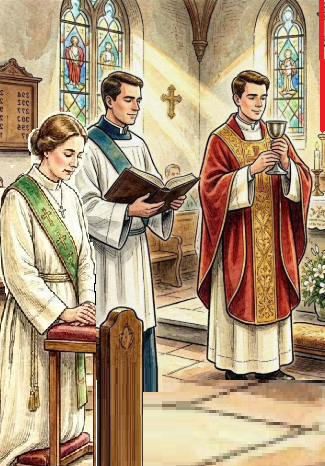
Note: It is out of this wise sensitivity toward ideas within the human heart that Appointed Deaconesses were given their non-ordained office in TACA in 2022.